Showing posts with label IAI. Show all posts
Showing posts with label IAI. Show all posts
June 21, 2017

June 16, 2015
Rafael introduces the I-Derby ER BVRAAM

RAFAEL is unveiling a new, extended range version of its Beyond Visual Range (BVR) active radar-guided air-to-air missile – the I-Derby ER. It is an evolutionary version of the Derby BVR missile unveiled earlier this year at Aero India. The Derby entered service in the mid-1990s and is fielded with six customers worldwide.
The latest variant is equipped with a new seeker that employs an advanced solid-state Software Defined Radar (SDR), based on combat proven technology derived from the Tamir missile, the interceptor used in RAFAEL’s Iron Dome system.
The new seeker is lighter and more compact than its predecessor, thus clearing valuable space which has been used by the missile designers to increase the propulsion system by adding a second mode (kick), accelerating the missile at the terminal phase of the flight. This new addition increases the range of the I-Derby ER beyond 100 km., significantly more than its current “short/medium” range capability.
This “second kick” greatly improves the missile’s performance. “This phase is not serial, but operates independently of the primary rocket propulsion as it is activated at any time during the fight, by the flight control system.” Yaniv explains. The second pulse would likely kick in when the missile is closing on its target, accelerating it and increasing its kinematic envelope, thus increasing its “no escape zone”.
The use of SDR technology means the missile seeker can be reprogrammed with software upgrades including new waveforms, duty cycles and processing techniques, addressing new threats, countermeasures and techniques that may evolve through its lifespan of 20-30 years.
Another advantage of the I-Derby ER is its ability to lock onto targets before and after launch, enabling the aircraft to engage targets at all ranges.
Currently completing development, I-Derby ER will soon be available for delivery for new orders, or replacement of existing stocks. “We already have several customers seeking long-range intercept capabilities, some are looking at I-Derby ER as the most suitable and affordable solution for their requirements,” says RAFAEL.
A major advantage of the I-Derby ER is that it uses the same missile envelope. Unlike the AAIM-120D or Meteor, I-Derby ER will be compatible with aircraft currently cleared to carry Derby. RAFAEL claims it will be able to deliver 80% of the Meteor’s performance at a third of its cost. It is also superior to the AIM-120C7 and more affordable, the company claims. Already cleared on F-16 (Block 52), F-5E, Kfir and Sea Harrier, I-Derby ER integration tests are currently under way on the Indian Tejas LCA.
November 12, 2014
Indo Israeli Barak 8 Missile Defense System successfully tested by IAI
IAI press release-
The Israel Aerospace Industries (IAI), in collaboration with the Israeli Ministry of Defense (IMOD), conducted a successful test of the Barak-8 Air & Missile Defense System yesterday, November 10.
Barak-8 is an advanced groundbreaking air and missile defense system that provides ultimate protection against a variety of aerial platforms, both land and naval scenarios. It is designed jointly with the DRDO (Defence Research and Development Organization) in India and is used by the IDF and the Indian defense forces. The system includes an advanced Phased Array digital radar, command and control, vertical launchers and missiles carrying a highly advanced seeker.
Barak-8 is regarded as an extensive project by the IMOD and is led by IAI, the prime contractor, in collaboration with IMOD’s Directorate of Defense Research and Development (DDR&D), ELTA Systems Ltd.- IAI’s group and subsidiary, RAFAEL Advanced Defense Systems, and other defense industries.
The current test validated all components of the weapon system to the satisfaction of the customer representatives. Israeli specialists and Indian scientists, including IMOD’s and DDR&D’s representatives participated in the test, along with both countries’ armed forces officers.
The scenario began with launching the target. After being detected by the System’s radar, the weapon system calculated the optimal interception point, launched the Barak-8 missile into its operational trajectory that acquired the target, and successfully intercepted it. All the weapon system’s components met the test’s goals successfully.

October 27, 2014
IAI ELTA showcase New Maritime Surveillance Radars at Euronaval 2014
Israel Aerospace Industries (IAI) has expanded its Maritime Surveillance Radar family. introducing two new models - the ELM-2022ML lightweight and compact radar, for helicopters and tactical unmanned systems, and the ELM-2022ES - employing mechanically rotating electronic scanned antenna array.
Same one on INS Kolkatta
Same one on INS Kolkatta
October 13, 2014
Indo-Israeli surface-to-air missile Barak 8 tested by Israeli Navy
Barak 8 missile successfully intercepted Yakhont(similar to Brahmos) anti-ship cruise missiles.
Israel's Channel 2 and israeldefense.com are reporting that the Israel Navy has conducted a successful secret test of the Barak 8 missile, which is designed to defend ships from the much-vaunted Yakhont anti-ship cruise missiles,
Photo - Wikipedia commons

The Israeli Navy conducted a trial a few months ago, declared as successful, of the upgraded Barak missile system for protection against Russian-made Yakhont missiles.The test was conducted within the framework of the upgrade of the navy's defense systems, designed to provide vessels protection from cruise missiles. Moreover, this system is able to protect the oil rigs at sea, namely – to provide protection to the exclusive economic zone of Israel and its most important energy sources.
According to what was cleared for publication, during the trial, a target missile was launched from sea, simulating the trajectory of the Russian-made missile. The Barak missile, launched from a naval missile boat, intercepted it.Military sources confirmed that the success of the trial provides an answer to the threat of cruise missile.The upgraded system is developed by Rafael and Israel Aircraft Industries, and an Italian company manufactured the missile simulator.
Also read:
http://www.israelnationalnews.com/News/News.aspx/186093#.VDuPl_mSwg0
-------
Seems India approved 262 Barak-1 only after Barak-8 project succeeded.
MODI APPROVES 262 ISRAELI BARAK-I MISSILES FOR NAVY on 26th September
India’s Prime Minister Narendra Modi has given final approval to the purchase of 262 Israeli Barak-I missiles for Indian Navy which will provide further boost to its growing capabilities.According to a report reaching here, the decision was made early this month by the Indian Cabinet Committee on Security headed by Prime Minister Modi.
The decision is considered a major breakthrough in stalled Indo-Israeli defence ties after series of bribery accusations against pro-Israeli officials of former government and defence high ups in India.
The new deal is expected to cost more than $144 million and may pave the way for further defence contract with Israel.According to insiders the delivery of Israeli Barak missile will begin as of 2015 and about fourteen Indian Naval ships are expected to be fitted with the Barak-1.
Israel's Channel 2 and israeldefense.com are reporting that the Israel Navy has conducted a successful secret test of the Barak 8 missile, which is designed to defend ships from the much-vaunted Yakhont anti-ship cruise missiles,
Photo - Wikipedia commons
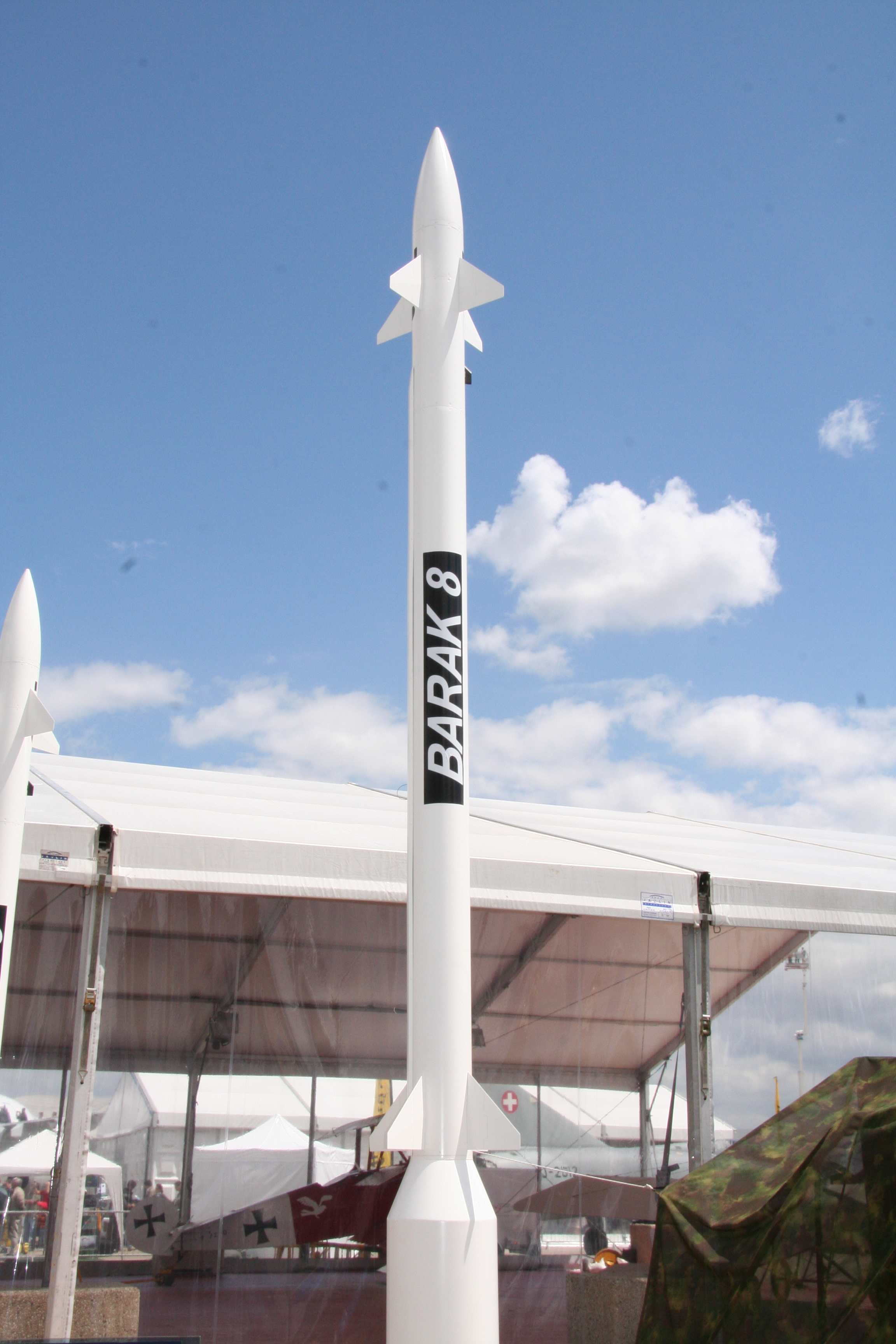
The Israeli Navy conducted a trial a few months ago, declared as successful, of the upgraded Barak missile system for protection against Russian-made Yakhont missiles.The test was conducted within the framework of the upgrade of the navy's defense systems, designed to provide vessels protection from cruise missiles. Moreover, this system is able to protect the oil rigs at sea, namely – to provide protection to the exclusive economic zone of Israel and its most important energy sources.
According to what was cleared for publication, during the trial, a target missile was launched from sea, simulating the trajectory of the Russian-made missile. The Barak missile, launched from a naval missile boat, intercepted it.Military sources confirmed that the success of the trial provides an answer to the threat of cruise missile.The upgraded system is developed by Rafael and Israel Aircraft Industries, and an Italian company manufactured the missile simulator.
Also read:
http://www.israelnationalnews.com/News/News.aspx/186093#.VDuPl_mSwg0
-------
Seems India approved 262 Barak-1 only after Barak-8 project succeeded.
MODI APPROVES 262 ISRAELI BARAK-I MISSILES FOR NAVY on 26th September
India’s Prime Minister Narendra Modi has given final approval to the purchase of 262 Israeli Barak-I missiles for Indian Navy which will provide further boost to its growing capabilities.According to a report reaching here, the decision was made early this month by the Indian Cabinet Committee on Security headed by Prime Minister Modi.
The decision is considered a major breakthrough in stalled Indo-Israeli defence ties after series of bribery accusations against pro-Israeli officials of former government and defence high ups in India.
The new deal is expected to cost more than $144 million and may pave the way for further defence contract with Israel.According to insiders the delivery of Israeli Barak missile will begin as of 2015 and about fourteen Indian Naval ships are expected to be fitted with the Barak-1.
June 8, 2014
March 24, 2014
Arjun Mark II Tank induction into the Indian Army could get delayed beyond 2016
The induction of Arjun MK II main battle tank into the Indian Army by 2016 may get delayed further due to the LAHAT Anti-Tank Guided Missile (ATGM).The Israelis -IAI- who customised the LAHAT Anti-Tank Guided Missile (ATGM) for firing from the 120 mm main gun of the Mark II variant, have gone back to the drawing boards for making the LAHAT to confirm to some Indian Army requirements.
LAHAT was originally developed 1992 by Israeli Aerospace Industries (IAI) for firing from their own Merkava MBT. With a diametre of about 105 mm, the anti-tank can be independently targeted or targeted through laser designation. The latter means an alternative platform can illuminate the target with the anti-tank guided missile (ATGM) homing in on the laser spot.
The range of the LAHAT missile pay-load is about three-and-a-half kilometres on the plains and about two-and-a-half kilometres in the deserts.
March 21, 2014
Harop Loitering Munitions System for the IAF
http://www.flightglobal.com/news/articles/india-could-buy-more-unmanned-harops-397122/
The Indian air force is evaluating the purchase of additional Israel Aerospace Industries Harop loitering munitions, as deliveries continue under a previous order placed in 2012.
The ground-launched Harop has some of the same capabilities as a tactical unmanned air vehicle, and features a high performance electro-optical/infrared camera. Once airborne, the system searches for, detects and attacks time-critical land- or sea-based static or moving targets, with claimed "pinpoint accuracy". IAI says the weapon can be employed across a variety of scenarios, including low and high intensity conflicts, urban warfare and counter-terrorist operations.
Capable of being launched from a variety of platforms, the long-endurance Harop has the capability of functioning as a tactical Unmanned Air Vehicle. The system can be used across a range of scenarios, from low to high-intensity conflicts, urban warfare and counter-terror operations. Equipped with an electro-optical/infrared seeker providing 360° coverage, the aircraft can search for, detect and attack from long range, high-value mobile, time-critical and moving targets on land or at sea and with pinpoint accuracy, as per IAI.After launch, a Harop air vehicle navigates towards a target area and loiters while searching for targets. If an attack mission is aborted, the UAV can be returned to loitering mode before making a new strike. Another Harop can be used to deliver real-time video to support battle damage assessment tasks.
The Indian air force is evaluating the purchase of additional Israel Aerospace Industries Harop loitering munitions, as deliveries continue under a previous order placed in 2012.
The ground-launched Harop has some of the same capabilities as a tactical unmanned air vehicle, and features a high performance electro-optical/infrared camera. Once airborne, the system searches for, detects and attacks time-critical land- or sea-based static or moving targets, with claimed "pinpoint accuracy". IAI says the weapon can be employed across a variety of scenarios, including low and high intensity conflicts, urban warfare and counter-terrorist operations.
Capable of being launched from a variety of platforms, the long-endurance Harop has the capability of functioning as a tactical Unmanned Air Vehicle. The system can be used across a range of scenarios, from low to high-intensity conflicts, urban warfare and counter-terror operations. Equipped with an electro-optical/infrared seeker providing 360° coverage, the aircraft can search for, detect and attack from long range, high-value mobile, time-critical and moving targets on land or at sea and with pinpoint accuracy, as per IAI.After launch, a Harop air vehicle navigates towards a target area and loiters while searching for targets. If an attack mission is aborted, the UAV can be returned to loitering mode before making a new strike. Another Harop can be used to deliver real-time video to support battle damage assessment tasks.
Subscribe to:
Posts (Atom)
