Showing posts with label Indian Weapons. Show all posts

October 17, 2015

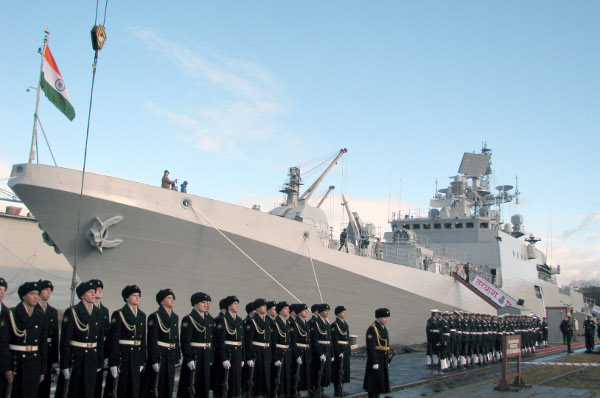
Indian, Japanese and US Navy officers all set for USS Fort Worth (LCS 3) presentation


 The littoral combat ship USS Fort Worth (LCS 3) completed the harbor phase of exercise Malabar in Chennai, India, Oct. 15.

Malabar 2015 is a complex, high-end warfighting exercise that has grown in scope and complexity over the years and is the latest in a continuing series conducted to advance multi-national maritime relationships and mutual security issues.

During the harbor phase in Chennai, the Fort Worth crew participated in subject matter expert and professional exchanges on maritime patrol and reconnaissance operations, surface and anti-submarine warfare, medical operations, damage control, helicopter operations and visit board search and seizure (VBSS) operations.

"The harbor phase training was quite beneficial to the crew," said Cmdr. Christopher Brown, commanding officer of Fort Worth. "This is the first time the crew of Fort Worth has had the opportunity to work and train with members of the Indian Navy and Japan Maritime Self Defense Force (JMSDF) and what we were able to learn from each other will go a long way towards advancing our interoperability."

Included during the harbor phase was a tour of the Fort Worth for sailors from the India Navy and JMSDF. During the tour, the sailors were given a presentation by sailors assigned to Helicopter Strike Squadron (HSM) 35, Detachment 3 on the MQ-8B Fire Scout unmanned aircraft system and were briefed on the capabilities of Fort Worth.

2015 marks the first time that a U.S. Navy littoral combat ship has participated in Malabar and will be the first time one has operated in the Indian Ocean, which will occur during the sea phase portion of Malabar.

"We are looking forward to getting to sea and participating in a number of complex surface warfare exercises," said Brown. "This is the first time a littoral combat ship has participated in Malabar and the sea phase provides a unique opportunity for Fort Worth to operate hull-to-hull with ships from the Indian navy and JMSDF."

Fort Worth will participate in a number of events during the sea phase of Malabar, including liaison officer professional exchanges and embarks; photo exercise; submarine familiarization, high-value unit defense; air and mine defense exercises; surface warfare, communications, gunnery, search and rescue and VBSS exercises; medevac; helicopter cross-deck evolutions; underway replenishments; and anti-submarine warfare. 

May 13, 2014

INS Vikramaditya awaits formal induction into Indian Navy


Country's biggest warship, INS Vikramaditya, is still awaiting its formal induction into the Indian Navy after five months of its arrival into Indian waters.

According to top government officials, impressed with its maritime capabilities, the outgoing prime minister, Manmohan Singh, had expressed his desire to spend a day on board the 44,500-tonne aircraft carrier procured from Russia. Sing along with the defence minister AK Antony was scheduled to dedicate the warship to the nation in the last week of March in a mega ceremony. But, the declaration of general elections and subsequent implementation of model code of conduct had put brakes on the scheduled programme of the UPA-II government. The defence ministry led by AK Antony first wanted to take clearance from the Election Commission to organise the event. But later on decided to leave it to the next government.

The $2.3 billion INS Vikramaditya was handed over to Indian Navy on November 16, 2013 at Sevmash, a Russian port. The warship arrived in Karwar on January 7 after 40 days of voyage. Since then, the warship has been stationed in Karwar naval base in Karnataka, but without adequate air defence guns for any protection against aerial attacks. However, the naval sources claim that the aircraft carrier always moves in a carrier battle groups, escorted by warships with all air defence weaponry. Refit of air defence guns on the aircraft carrier will take place soon.

"Yes, the formal induction of INS Vikramaditya has been delayed. But, the aircraft carrier is now capable of its full deployment. Fighter aircraft such as MiG 29 have embarked and being flown by Indian naval pilots. So far, we have trained 10 MiG 29 naval pilots, who have been trained to operate from INS Vikramaditya,"said an officer.INS Vikramaditya has an overall length of about 284 metres and a maximum beam of about 60 metres, stretching as much as three football fields put together. Standing about 20-storey tall from keel to the highest point, the sheer sight of this 44,500-tonne mega structure of steel is awe inspiring. The ship has a total of 22 decks. With over 1,600 personnel on board, Vikramaditya is literally a 'Floating City'.The ship has the ability to carry over 30 aircraft comprising an assortment of MiG 29K/Sea Harrier, Kamov 31, Kamov 28, Sea King, ALH-Dhruv and Chetak helicopters.

INS Vikramaditya is a Kiev class aircraft carrier which was commissioned by Russian Navy in 1987 under the name Baku. It was later renamed as Admiral Gorshkov and last sailed in 1995 in Russia, before being offered to India.


http://www.dnaindia.com/india/report-ins-vikramaditya-awaits-induction-1987239

May 12, 2014

Air Defense: India Buys Israeli Tech To Stop Hostile Missiles

Discussion happening on Chinese military websites on the point mentioned below:
http://mil.sina.cn/?sa=t134d415443v76&pos=24&vt=4


If the new system works China and Pakistan could only defeat it by firing more missiles simultaneously than the Indians could handle


India is hiring several Israeli defense firms to work with DRDO (the Indian Defense Research and Development Organization) and several state-owned defense firms to design and build an integrated anti-missile defense system. India already has a tested and proven anti-missile ABM (Anti-Ballistic Missile) but wants something like the anti-missile system Israel has developed and deployed over the last two decades. This may involve buying the latest models of Israeli Green Pine radar, which is a key element of the Israeli anti-missile defenses.

In late 2013 India conducted a final round of development tests of its ABMs. This involved intercepting multiple incoming ballistic missiles and was declared a success. As a result of this, and several other successful earlier tests, Indian missile development officials declared that their anti-missile missiles were ready for mass production and deployment. This would provide some Indian cities protection from Pakistani or Chinese ballistic missiles. But the Indians realized that just having a reliable interceptor missile was not enough. You needed an integrated communications and radar warning system. The Israelis and the Americans are the only ones with years of experience with such anti-missile systems and India was already a steady customer for Israeli weapons and electronics systems.

The Indian anti-missile missiles come in two sizes. The Prithvi Air Defense (PAD) missile is the larger of the two and is used for high altitude (50-80 kilometers up) interception. The short range Advanced Air Defense (AAD) missile is used for low altitude (up to 30 kilometers) intercepts. The two missiles, in conjunction with a radar system based on the Israeli Green Pine (used with the Arrow anti-missile missile), provide defense from ballistic missiles fired as far as 5,000 kilometers away. A third interceptor, the PDV, is a hypersonic missile that can take down missiles as high as 150 kilometers and is still in development. India is the fifth nation to develop such anti-missile technology.

The Indian system has been in development for over a decade. Back in 2003 India ordered two Israeli Green Pine anti-ballistic missile radars. That equipment was used in 2007 in one of the first successful Indian tests, where one ballistic missile was fired at another "incoming" one. The Israeli Green Pine radar was originally developed for Israel's Arrow anti-ballistic missile system. Arrow was built, in cooperation with the United States, to defend Israel from Iranian and Syrian ballistic missiles. India has since developed, with Israeli help, the Swordfish radar, which has similar capabilities to the Green Pine and has been operational since 2011. Swordfish is part of a system that integrates data from satellites and other sources in order to detect and track incoming missiles.

The interceptor missiles and the fire control systems were designed and built in India, although more Israeli technology may have been purchased to speed things along. India wanted to buy the entire Israeli Arrow system but the United States refused to allow the sale (which involved a lot of American technology). The new deal with Israel is apparently supposed to get around those restrictions.

The Indian ABM system wasn’t supposed to become operational until 2015. But the developers believed it was ready in 2014 and asked parliament for money to start building systems to defend places like New Delhi (where parliament is). At that point there was a debate over the state of the Indian technology and some Indian officials doubted that the ABM system would be operational, even if just around New Delhi using just Indian technology. Questions were asked about just how effective the Indian ABM system really was. India has a shabby reputation with developing weapons. Projects go on for decades, often passing tests but without ever producing operational weapons. Joint-ventures with other countries (like Russia, France, and Israel) have been more successful. Israel was apparently more heavily involved with the Indian ABM than official pronouncements indicated. So it made sense to go public with heavier Israeli participation to get the Indian ABMs operational. If nothing else that would scare, or at least annoy, the Chinese more.

If the new system works China and Pakistan could only defeat it by firing more missiles simultaneously than the Indians could handle. It's also possible to equip warheads with decoys in an attempt to get the interceptor missile to miss. Israel has technology designed to deal with these decoys and India was attracted to that. But against an overwhelming number of incoming missiles, some are going to get through. Yet if you have a defensive system and the other guy does not, you have a big advantage no matter what.


https://www.strategypage.com/htmw/htada/20140305.aspx

May 5, 2014

India successfully tests air-to-air Astra missile

Image credit: DRDO


India successfully test-fired its first indigenously developed air-to-air missile, Astra, from a Sukhoi-30MKI combat jet on Sunday - a much-delayed milestone on the road to the new weapon’s induction into the IAF’s arsenal. Astra’s test was part of a series of missile trials lined up by the Directorate of Defence Research and Development Organisation (DRDO). A few days ago, India had successfully demonstrated its capability to intercept an incoming hostile ballistic missile.Scientists are now working on the Nirbhaya subsonic cruise missile, which will be test-fired soon. Its first trial was unsuccessful.

Astra was test-fired at a naval range in the western sector, but it will be some time before it takes on a target. The first test only entailed firing from the aircraft and defence scientists were satisfied by its performance. The DRDO is aiming at making Astra one of the mainline weapons for the entire fleet of IAF fighters, ranging from the Sukhois to the Light Combat Aircraft (LCA) Tejas which is still under development. This would mean that once proven, the missile will have to be produced in large numbers.

The road to the first test from an aircraft was not easy. Extensive ground trials took place before the missile was integrated to the aircraft. Astra is being developed in two stages.In the first phase, the missile will have a range of around 40 km and this will eventually be extended to 100 km in the next phase. “The test firing met all the mission objectives and the air launch was captured by side and forward looking high speed cameras.The separation was exactly as per simulation,” DRDO said in a statement. Astra will undergo a series of trials now as the development process moves towards using the missile to destroy a target.The new missile has high single shot kill probability, which enhances its accuracy. The DRDO said it is an advanced missile which can be fired in all weather conditions.

It has features like active radar terminal guidance, electronic counter-countermeasures and smokeless propulsion. The success of the trial assumes significance as scientists managed to overcome serious design issues, which made it difficult to control the missile. After Astra, all eyes are now on the test of the Nirbhaya subsonic cruise missile. The long-range missile was first fired last year, but it had to be destroyed mid-course after it deviated from the designated path. Though the trial was described as unsuccessful, the DRDO explained it as a partial success. The missile lifted off as planned and crossed designated way points on the way to the target.


http://www.dailymail.co.uk/indiahome/indianews/article-2620130/India-tests-air-air-missile.html


Here is how the Indian stupid paid media reported this. The picture is of a Prithvi missle


                           Freedom from Queen bee and freedom from(of) the press(paid)

April 28, 2014

India test-fires anti-ballistic missile


In a significant milestone in the direction of developing a two layered Ballistic Missile Defence system, India today successfully carried out its maiden Prithvi Defence Vehicle (PDV) test-fire meeting the mission objectives."PDV mission is for engaging targets in the exo-atmosphere region at more than 120 km altitude," Defence Research Development Organisation (DRDO) said in a statement after the trial conducted on Odisha coast.

"Both the PDV interceptor and the two stage target equipped with motors were specially developed for the mission. The target, developed for mimicking a 'hostile Ballistic Missile approaching from more than 2000 km away', was launched at 0907 hrs from a Ship in the Bay of Bengal," it said.
"In an automated operation, radar based detection and tracking system detected and tracked the enemy's ballistic missile. The computer network with the help of data received from Radars predicted the Trajectory of the incoming Ballistic Missile," it said.

PDV that was kept fully ready, took-off from the Integrated Test Range (ITR) at Wheeler Island, about 100 km from here, once the computer system gave the necessary command for lift-off, the DRDO release said."The Interceptor guided by high accuracy Inertial Navigation System (INS) supported by a Redundant Micro Navigation System moved towards the estimated point of the interception," it said.Once the Missile crossed atmosphere, the Heat Shield ejected and the IR (Infrared) Seeker dome opened to look at the target location as designated by the Mission Computer. With the help of Inertial Guidance and IR Seeker the Missile moved for interception.


http://www.business-standard.com/article/current-affairs/pdv-test-fire-a-significant-step-drdo-114042700250_1.html

March 3, 2014

India's Arjun MBT Mk II gears up for final leg of user trials


Defence scientists of Avadi (near Chennai) Combat Vehicle Research Development Establishment (CVRDE) are all set to take India's Arjun Main Battle Tank (MBT) Mk II for the concluding phases of user trials.

During the fourth phase of trial, the tank will have to be tested for obstacle crossing and medium fording (water) capabilities. "The concluding phases of the user trials will begin in May 2014.


Indian Army sources say that a few of the improvements need to be further refined. Sources said that the missile (Israeli LAHAT) firing trials need to be conducted again for further validation. DRDO says it is confident that the Arjun MBT Mk II will prove its worth in the final leg of the user trials.

February 28, 2014

India successfully tests Akash SAM


 For the third time in a span of five days, India successfully test-fired the indigenously developed surface-to-air missile Akash missile system from the Integrated Test Range at Chandipur in Odisha on Wednesday. These were part of a series of tests being conducted in various engagement modes from the first of Production Model system produced to equip two regiments of the Army, Directorate of Public interface, Defence Research and Development Organisation (DRDO) director Ravi Kumar Gupta said.

Earlier tests flights, destroying a target in receding floating mode, as well as the one destroying an approaching target, fully met the mission objectives, a senior defence scientist said.Akash is India’s first indigenously designed, developed and produced air defence system missile capable of engaging aerial threats up to a distance of approximately 25 km.The multi-target, multi-directional, all-weather air-defence system consisting of surveillance and tracking radars is designed to enable integration with other air defence command and control networks through secured communication links.

Developed by DRDO, Akash is being produced by Bharat Dynamics Limited (BDL) as the nodal production agency with the involvement of Bharat Electronics Limited (BEL) and a large number of other industries.The total production value of Akash air defence systems cleared for induction by Indian Army and Indian Air Force is more than Rs 23,000 crore.

January 27, 2014

India unveils new local-made Arjun Mk-II main battle tank at the Republic Day Military Parade 2014


The Arjun Mk.II MBT (Main Battle Tank) was unveiled for the first time to the public at India's 65th Republic Day Military Parade, January 26, 2014. Thle latest version of Arjun MBT is aimed at exemplifying DRDO’s strength in the area of defence technology – design and development, leading to the production of state of the art weapon systems for India’s armed forces.


July 31, 2013

Indian Navy's N-powered submarine - Arihant - all set to sail out from Vizag, India


Indigenously built nuclear-powered submarine, INS Arihant, is finally set to sail out from its base at Vishakhapatnam. The 6,000-tonne submarine, armed with nuclear missiles, is ready after years of efforts interspersed with sanctions in 1998 and impediments due to non-availability of cutting-edge technology.


“The nuclear reactor that will power the submarine can be formally declared ‘critical’ anytime now, while the nuclear-tipped missiles to be launched from underwater are in place,” sources said.
“Everything is ready,” a functionary said. “The wait is for the monsoon to subside before Arihant (slayer of enemies) dives into sea. A certain amount of calm is needed at sea when the vessel goes out the first time. The monsoon on the East Coast starts weakening by the middle of August, meaning the submarine will slither out in a couple of weeks from now,” he added.
“Around 95 per cent of harbour trials are over,” sources said. Once the submarine is out at sea, it will run on nuclear-powered 80MW pressurised water reactor (PWR). The PWR was developed by the Bhabha Atomic Research Centre (BARC) with assistance from a Russian designing team. It uses enriched uranium as fuel and light water as coolant and moderator.

Once at sea, the vessel will be gradually loaded with weapons and missiles. All parameters will be tested after each addition. “Each test will be conducted underwater for two months or more. This will include the Submarine Launched Ballistic Missile (SLBM)”, sources said.
New Delhi has done 10 underwater launches of SLBMs code named ‘B05’ using a submerged pontoon to mimic a submarine. It can travel 700 km, while the bigger variant, so far know as the ‘K-4’, can hit targets 3,500 km away and will finally be installed on Arihant and also the next two follow-on submarines of the same class.

The submarine will provide second-strike capability in case of a nuclear attack. It is the easiest to launch a nuclear strike from a submarine as it remains submerged, hence the enemy cannot detect it.
In December 2010, the then Navy Chief Admiral Nirmal Verma had announced: “When Arihant goes to sea, it will be on a deterrent patrol (armed with nuclear-tipped missiles).” Being nuclear-powered, the submarine will not have to surface for two months to breath, like the conventional vessels have to.

India will join the US, the UK, France, and China by having such technology and prowess.
Arihant has cost Rs 15,000 crore. It has been jointly developed by the Navy, BARC and the Defence Research and Development Organisation (DRDO) at the Visakhapatnam naval dockyard. Russian designers assisted in building the vessel. Other companies involved in the development of the submarine are Tata Power and Larsen & Toubro (L&T). The project, earlier known as the advanced technology vessel (ATV), has been under development since 1998.
 

April 13, 2013

Indo-Russian Fifth generation fighter crosses milestone


India and Russia have crossed the first milestone towards the development of the fifth generation fighter aircraft (FGFA), completing the preliminary design of the plane.
“The preliminary design contract (PDC) for the Russian-Indian fifth generation aircraft has been executed,” Russia’s Sukhoi aircraft company announced on Wednesday. 

The Hindustan Aeronautics Limited (HAL) signed the $295-million PDC contract in December 2010 with the Sukhoi company, which is responsible in Russia for developing the PAK-FA (perspective aviation complex-frontline aircraft), as the FGFA is called in Russia.
“The aircraft design has been fully developed,” Sukhoi said in a press release. “Both parties have agreed upon on the amount and division of work during the research and development (R&D) stage. A contract for the R&D is being prepared. It is to be signed this year.”Under the PDC contract Sukhoi has also trained Indian engineers and provided HAL with the data and software needed to create a single working environment. A team of HAL engineers and IAF experts has been working at Sukhoi’s design bureau in Moscow, while Russian engineers have been assigned to HAL.
Four T-50 aircraft, the Russian prototype of the fifth generation fighter, have already performed more than 200 test flights since January 2010. 
 
The customised FGFA version will have “some differences” from the Russian prototype to meet “specific requirements of the Indian Air Force,” the Sukhoi announcement said. 

Russian experts said the FGFA will differ in “mission hardware and software,” as well as weapons. India has dropped its initial plan to redesign the single-seat T-50 into a twin-seat version.
Air Chief Marshal N.A.K. Browne told reporters at Aero India-2013 that India is to receive from Russia the first prototype of the fifth-generation fighter in 2014, followed by two more in 2017 and 2018. The FGFA is expected to go into series production by 2022.This is India’s biggest-ever defence project and its largest defence deal with Russia. It is expected to cost India more than $30 billion. However, last year India scaled down its original plan to acquire 214 planes by one-third, to 144 aircraft, citing time and cost factors. Russia plans to induct 60 planes at an estimated price tag of $100 million per aircraft.

January 3, 2013

Sea trials for nuke submarine INS Arihant set to begin soon


View Larger Map

Indian Navy's nuclear submarine INS Arihant (destroyer of enemy) appears to be caught up in a significant development after a delay that led to the extension of sea trial timeline set for the boat.

It is believed that the reactor will go critical, setting the stage for sea trial sometime in the first half of next year. Admiral Joshi said harbour acceptance trials for the under development boat have been completed.

With the reactor going critical, Arihant would be taken to the sea for elaborate trials. Joshi's predecessor Nirmal Verma had earlier hinted that India's strategic ambition of having a credible nuclear triad would be in place by the end of this year.

But there has been a delay and the sea trials are expected to begin only next year. The reactor's performance will be tested in various stages, including firing of weapons and operations in the depth of the ocean. If everything remained in place, the submarine is expected to be ready for induction by 2014.

It will be one of the most significant achievements of India's submarine building capability.The submarine will be fitted with K-15 submarine launched ballistic missile which is under development. The trials of 700 km K-15 missile have already been carried out. While Arihant's induction is being eagerly awaited, the navy has fully integrated recently acquired Akula class submarine from Russia.

 Indian navy had earlier inducted INS Chakra nuclear powered submarine

December 27, 2012

Indian Navy : After successful launch, K-15 missile ready to join Arihant nuclear submarine


The Defence Research and Development Organisation (DRDO) ends 2012 on an upbeat note, successfully launching the underwater missile K-15 off the Visakhapatnam coast on Wednesday. The missile darted 20 km into the air, after a gas generator ejected it from the pontoon that lay submerged a few scores of metres in the Bay of Bengal, and sped 650 km before splashing into the sea in its 11th flight trial. 

After one more flight, the two-stage missile will be integrated with Arihant, India’s nuclear-powered submarine, and test-fired from the ship. “It is a fantastic system. It is a very powerful and accurate system,” said A.K. Chakrabarti, Programme Director, K-15, and Director of the Hyderabad-based Defence Research and Development Laboratory (DRDL), which designed and developed the missile.
“India is the fifth country to have an underwater launch system. The other countries are the U.S., Russia, France and China,” he said. 

November 13, 2012

Indian Navy inducts Frigate INS Tarkash


INS Tarkash, the second of the three stealth Frigates constructed at Yantar Shipyard, Kaliningrad Russia, has been commissioned and inducted into the Indian Navy by Vice Admiral Shekhar Kumar Sinha, Flag Officer Commanding-in-Chief, Western Naval Command on 09 November 2012 at Kaliningrad, Russia. The array of weapons and sensors onboard the ship include the supersonic Brahmos missile system, advanced Surface to Air missile system, upgraded 100mm medium range gun, optically controlled 30 mm Close-in Weapon System, Torpedoes, Rocket Launchers and advanced Electronic Warfare/Communication suite. The ship is commanded by Captain Antony George, an ‘Anti Submarine Warfare’ specialist. The ship will join the Western Fleet of the Indian Navy by December end, this year.


September 9, 2012

India Plans Robots To Replace Soldiers

http://www.aviationweek.com/Article.aspx?id=/article-xml/asd_12_15_2011_p04-03-405438.xml


NEW DELHI — Indian scientists are in the process of developing robots to replace human soldiers in the near future as part of the country’s unmanned warfare system.
A new research facility has been set up by the Defense Research and Development Organization (DRDO) and BEML Ltd., the state-run heavy engineering and defense equipment major, in Avadi, a suburb of Chennai in south India, to make robot soldiers and cargo-transporting robots for the country’s army.

“Whatever a soldier will do in warfare, a robot soldier should be able to do. If the human is doing a search in warfare, the robot soldier will also do that. If a human is doing firefighting, the robot soldier will do that,” says V.K. Saraswat, DRDO’s director general and scientific adviser to India’s defense minister. “The DRDO is working on the project to have robot soldiers by 2020 or 2030,” he says.
The robot soldiers will be able to perform duties including carrying loads of ammunition and payloads for mine detection and surveillance. Saraswat says they can be controlled from remote locations, which would help the country’s armed forces by not having to deploy people in areas which are difficult to access. “Such a robot needs a database and artificial intelligence to carry out its activities,” Saraswat says. “A lot of effort and coordination among various agencies in the defense sector [will be] needed to develop these robots.”

The new robot soldiers are likely to replace at least some of India’s 100,000 soldiers.
In a separate project, DRDO is planning to design robotic mules that can replace the animals used by Indian soldiers to carry heavy loads in mountainous terrain.


August 7, 2012

India Navy's ‘K-15 Black Project’


India has quietly gate-crashed into an even more exclusive club of nuclear-tipped submarine-launched ballistic missiles (SLBMs). Project found out when top scientist given award


The annual awards function of the Defence Research and Development Organization (DRDO) the other day witnessed Prime Minister Manmohan Singh handing over the “technology leadership award” to a scientist, A K Chakrabarti, of the Hyderabad-based DRDL lab, for the “successful development” of the country’s first SLBM. This capability has been acquired only by four nations, the US, Russia, France and China. Long shrouded in secrecy as a “black project”, unlike the surface-to-surface nuclear missiles like Agni, the SLBM may now finally come out of the closet. Called different names at different developmental phases, which included “Sagarika’’ for an extended period, the SLBM in question is the ‘K-15’ missile with a 750-km strike range. Much like the over 5,000-km Agni-V that will be fully operational by 2015 after four-to-five “repeatable tests”, the K-15 is also still some distance away from being deployed. While the SLBM may be fully-ready and undergoing production now, as DRDO contends after conducting its test several times from submersible pontoons, its carrier INS Arihant will take at least a year before it’s ready for “deterrent patrols”.

India’s first indigenous nuclear-powered submarine, the 6,000-tonne INS Arihant, is still undergoing “harbor-acceptance trials” with all its pipelines being cleared and tested meticulously on shore-based steam before its miniature 83 MW pressurized light-water reactor goes “critical”. The submarine will then undergo extensive “sea-acceptance trials” and test-fire the 10-tonne K-15, which can carry a one-tonne nuclear payload, from the missile silos on its hump.

The sea-based nuclear leg in the shape of SLBMs is much more effective — as also survivable being relatively immune to pre-emptive strikes — than the air or land ones. Nuclear-powered submarines, which are capable of operating silently underwater for months at end, armed with nuclear-tipped missiles are, therefore, considered the most potent and credible leg of the triad. With even the US and Russia ensuring that two-thirds of the strategic warheads they eventually retain under arms reduction agreements will be SLBMs, India with a clear “no-first use” nuclear doctrine needs such survivable second-strike capability to achieve credible strategic deterrence.


July 17, 2012

2nd Boeing P-8I Neptune submarine hunter for Indian Navy Completes 1st Flight


Click to enlarge

The second Boeing P-8I aircraft for the Indian Navy completed its initial flight on July 12, taking off from Renton Field at 3:29 p.m. and landing two hours and 14 minutes later at Boeing Field in Seattle. The P-8I, a derivative of the Boeing Next-Generation 737-800 commercial airplane, is the second of eight long-range maritime reconnaissance and anti-submarine warfare aircraft Boeing is building for India.
The program is on plan and the Indian Navy is excited for the P-8I to join its fleet," said Leland Wight, P-8I program manager for Boeing.

During the flight, Boeing test pilots performed airborne systems checks and took the P-8I to a maximum altitude of 41,000 feet prior to landing. Boeing will begin mission systems installation and checkout work on the aircraft in the coming weeks.


Related Posts Plugin for WordPress, Blogger...