Showing posts with label South Korean Weapons. Show all posts

October 16, 2016

December 18, 2015

South Korea launches second next-generation troop landing ship


South Korea on Tuesday launched its second next-generation landing vessel with upgraded mobility that will be deployed for operations in 2017, the navy said.

The second edition LST-II, the Cheonjabong, is 4,900 tonnes and is capable of doing 23 knots at full speed with a complement of 120 crew members, the Korea Herald reported.

The vessel, built by Hyundai Heavy Industries, is capable of delivering about 300 fully armed military personnel and also carry landing boats, tanks and two helicopters, the navy said.

The landing vessel is equipped with a domestically developed combat system and command post for landing operations. The next-generation ship has higher mobility compared with the navy's four landing vessels of the Go Jun Bong-class LST-1.

During peacetime, the new ship will carry out transport missions and shift to response operations in the event of conflict.

The vessel will undergo performance tests before being delivered in late 2016.

November 10, 2014

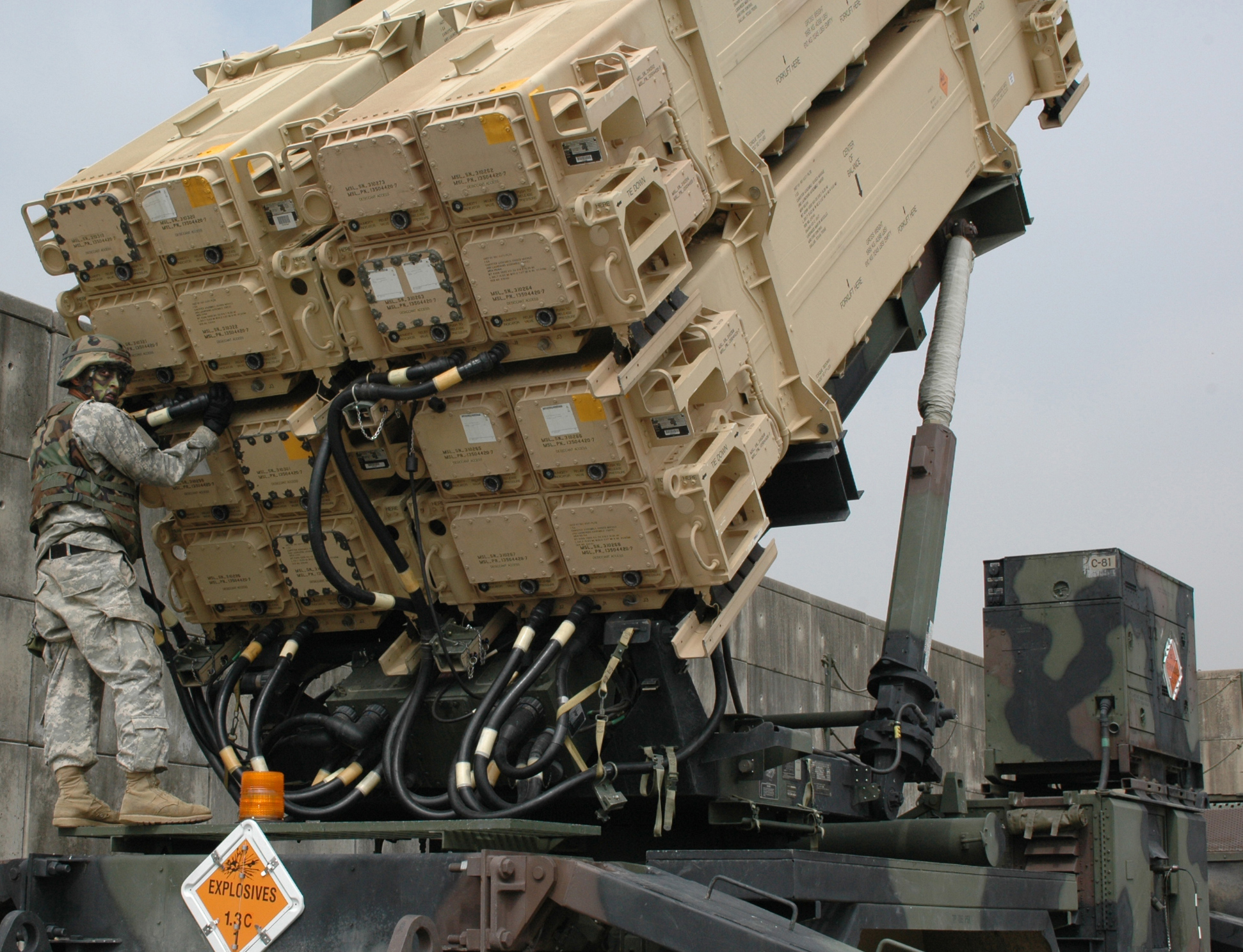
South Korea to Buy PAC-3 interceptor missiles from U.S


Photo - Wikimedia commons


http://www.dsca.mil/major-arms-sales/republic-korea-patriot-advanced-capability-pac-3-missiles

The State Department has made a determination approving a possible Foreign Military Sale to the Republic of Korea for Patriot Advanced Capability (PAC-3) missiles and associated equipment, parts and logistical support for an estimated cost of $1.405 billion. The Defense Security Cooperation Agency delivered the required certification notifying Congress of this possible sale today.

The Republic of Korea (ROK) has requested a possible sale of 136 Patriot Advanced Capability (PAC-3) Missiles with containers and 2 Flight Test Targets (Patriot-As-A-Target (PAAT) modified short-range tactical ballistic missiles). Also included are 2 PAC-3 Telemetry Kits, 10 Fire Solution Computers, 18 Launcher Stations Modification Kits, 8 Missile Round Trainers, 8 PAC-3 Slings, 10 Patriot Automated Logistics System Kits, 13 Installation Kits for TPX-58 Identification Friend or Foe with KIV-77, PAC-3 Ground Support Equipment (GSE),10 Shorting Plugs, 77 Defense Advanced Global Positioning Receivers (DAGRs) and Installation Kits, Patriot Fiber Optic Modem, 8 Guided Missile Transporters, 4 AN/VRC-90E Radios with Installation Kits, spare and repair parts, support equipment, communication equipment, publications and technical documentation, personnel training and training equipment, U.S. Government and contractor logistics and technical support services, Quality Assurance Teams’ support, and other related elements of logistics and program support. The estimated cost is $1.405 billion.

This proposed sale will contribute to the foreign policy and national security objectives of the United States by meeting the legitimate security and defense needs of an ally and partner nation. The ROK is one of the major political and economic powers in East Asia and the Western Pacific and a key partner of the United States in ensuring peace and stability in that region. It is vital to U.S. national interests to assist our Korean ally in developing and maintaining a strong and ready self-defense capability.

The ROK requires the PAC-3 missiles to effectively conduct and sustain BMD operations, as well as serve as a core component to the ROK’s future Korea Air Missile Defense (KAMD). This sale will increase interoperability between the ROK’s ground and sea-based (Aegis) BMD forces and U.S. Forces Korea (USFK), which not only affects ROK national security but also the security of the U.S. personnel assigned in the ROK. This sale will provide the ROK with the capability to defeat lower tier Ballistic Missile Defense (BMD) threats, and will decrease the ROK’s reliance on the deployment of U.S. combat forces to maintain stability in the region.

The proposed sale of this equipment and support will not alter the basic military balance in the region.

The principal contractors will be Raytheon Corporation in Andover, Massachusetts; and Lockheed Martin Missiles and Fire Control in Dallas, Texas. There are no known offset requirements in connection with this potential sale.Implementation of this proposed sale will not require the assignment of any additional U.S. Government or contractor personnel to Korea. However, U.S. Government or contractor personnel will be required, on a temporary basis, to conduct in-country visits in conjunction with program technical and management oversight and support requirements.

There will be no adverse impact on U.S. defense readiness as a result of this proposed sale.

This notice of a potential sale is required by law and does not mean the sale has been concluded.

October 8, 2014

Korean Air Lines Co delivers 4,000th refurbished military plane


Photo - Yonngong


Korean Air Lines Co. said Wednesday that it has delivered its 4,000th refurbished military plane, 36 years after it started depot maintenance operations.The company, South Korea's largest air carrier and logistics giant, held a ceremony in Busan, to mark the delivery of an F-15 air-superiority fighter jet to the U.S. Air Force, and outlined its goal to play a leading role in the global aerospace sector.
It started maintenance work in 1978 by repairing and overhauling planes operated by the South Korean and U.S. military. It has a maintenance tech center built on 707,866 square meters of land in Busan, 453 kilometers southeast of Seoul. This facility has a factory space of 266,180 square meters and employs some 2,700 people.

"This facility is the largest depot maintenance center in the country and the only one used by U.S. military aircraft in the Asia-Pacific region," the company said. It stressed that its prowess in maintenance and experience gained in the license production of aircraft in the past, gives it a unique position that can ensure growth of its aircraft industry sector as a whole.Korean Air started by carrying out maintenance work on C-123 cargo planes, 500MD helicopters, and F-5 and F-4 jets but has since moved onto repairing high-performance KF-16 and F-15 aircraft.

A partnership with the United States military began in 1979, with local engineers conducting maintenance work on F-16, F-15, KC-130Js tankers and A-10 ground attack aircraft.The company has also successfully assembled light helicopters and jet fighters as well as the UH-60s and KF-16 jets used by the South Korean Air Force

July 7, 2014

South Korea launches 5th 1,800-ton-class attack submarine


South Korea launched its fifth 1,800-ton-class attack submarine on Thursday as part of efforts to boost its underwater warfare capabilities against North Korean submarines, the Navy said.The 214-class submarine, named after famous independence fighter Yun Bong-gil (1908-1932) and manufactured by Hyundai Heavy Industries Co., will be delivered to the Navy in late 2015 and commissioned the next year, a Navy officer said.The ship is armed with indigenous ship-to-ship cruise missiles named Haeseong, or Sea Star, torpedoes and mines for anti-submarine warfare. The cruise missiles with a maximum range of 1,500 kilometers are capable of carrying out precision strikes against enemies' key facilities, he noted.The sub's maximum underwater speed is 20 knots, which enables it to ply between South Korea and Hawaii without refueling.

The diesel-powered submarine is equipped with an air independent propulsion system, which enables the crew to carry out underwater missions for about two weeks without access to atmospheric oxygen, the officer said.South Korea operates more than 10 submarines, including 1,200-ton Type 209 subs and 1,800-ton Type 214 subs.North Korea is known to have about 70 submarines, including a 1,800-ton Romeo-class submarine that the communist country made public last month with its leader Kim Jong-un conducting a drill while standing on its turret.

May 27, 2014

South Korea to resume production of homegrown torpedo after quality improvement


South Korea has successfully improved the quality of a homegrown torpedo, paving the way for its long-delayed mass production, the state arms procurement agency said Monday.In a test-firing on Friday, the torpedo, named "Hongsangeo," or "Red Shark," hit its intended underwater target, marking its third straight successful quality test, according to the Defense Acquisition Program Administration (DAPA)."After two years of efforts, the torpedo has now met the requirement of hitting the target successively for three rounds. The results show that its quality has been improved enough to resume its production," a DAPA official said.

About 50 rounds of the anti-submarine torpedo had already been deployed since 2010, but its production was suspended after the torpedo had failed to work properly, prompting the Navy to file complaints over its quality in July 2012.The military has since conducted two rounds of additional tests, but the torpedo had failed to meet a required accuracy rate until last year, raising questions about its design."After conducting a comprehensive technology analysis for about six months till April, we've finally learned what caused the failure, and then changed some parts to boost its resistance from external shocks," the official said."Following the successful third round of the test-firing this time, production is expected to resume next month," he added.

The state-funded Agency for Defense Development created the Hongsangeo over a nine-year period starting in 2000 with a budget of 100 billion won (US$97.6 million). Some of the Navy's destroyers were loaded with the 5.7-meter-long torpedoes in early 2012.The two-stage torpedo is launched vertically from a destroyer and flies about 20 kilometers before dropping into the sea to track and destroy a target.A precision-guided weapon like Red Shark should demonstrate more than a 75 percent success rate to be suited for combat assignment."Taking this quality improvement as an opportunity, we will strive to provide the military with highly reliable precision-guided weapons," DAPA chief Lee Yong-geol said.


http://english.yonhapnews.co.kr/national/2014/05/26/47/0301000000AEN20140526001951315F.html

May 13, 2014

Taurus Systems to open Seoul office this week


South Korean F-15K loaded with a Taurus missile
Taurus Systems said Sunday that it will open an office in Seoul on Tuesday ― the company’s first outside Germany.The joint German-Swedish venture is the manufacturer of the Taurus KEPD 350 long-range cruise missile that will be loaded on the Korean Air Force's F-15Ks.
The Defense Acquisition Program Administration (DAPA), the nation's arms procurement agency, signed a deal to purchase the air-to-surface stand-off missiles in November.

The office will take charge of various tasks regarding the Air Force's acquisition of the missile and also support other work such as technology transfer and joint development of the next cruise missile.
"We are very happy to be a large step closer to our aim of supporting our customers in Korea as best as we can, and to offer an efficient infrastructure, with the opening of the office in Seoul," said Christoffer Drevstad, vice president of Taurus Systems.

"This is the first time for Taurus Systems to open an office outside Germany. This will ring in a new era and be very meaningful for our company."Thanks to the bunker-busting missiles that can fly over 500 kilometers, the Air Force is now capable of striking targets with pin-point accuracy anywhere in North Korea without aircraft entering its airspace, including nuclear and missile facilities and  penetrating several meters of reinforced concrete.

In addition, the Taurus has three independent navigation systems ― terrain reference, imagery, and GPS ― that makes it very resistant to any form of signal jamming.The Taurus is the first European missile to be integrated onto a Korean fighter aircraft. The missile is expected to improve survival statistics of the fighter and its pilot as well as being an effective strategic threat as a deterrent against war.


http://www.koreatimes.co.kr/www/news/nation/2014/05/116_156960.html


May 1, 2014

South Korea to upgrade missile defense


South Korea on Monday approved a plan to purchase scores of Patriot Advanced Capability-3 missiles from the U.S. for deployment from 2016-2020, the state defense acquisition agency said.During a top defense decision-making meeting presided over by Defense Minister Kim Kwan-jin, Seoul endorsed the plan that also includes upgrading the current missile interception system from 2014 through 2020. The upgrading work includes enhancing radars, launchers and control programs.

The government has set aside a budget of between 1.3 trillion won ($1.25 billion) and 1.4 trillion won for the plan aimed at countering North Korea’s persistent missile threats. Seoul plans to purchase the hit-to-kill PAC-3 missiles from the U.S. through a government-to-government foreign military sale method, while the project to upgrade the interception system will be carried out through a competition, which would invite European firms such as MBDA of Germany.

Seoul has been pushing to upgrade its interception system and purchase advanced missile interceptors as it seeks to build its own independent missile defense system, called the Korea Air and Missile Defense.The KAMD is a low-tier, multiple-interception program, which destroys incoming missiles at an altitude of 40-50 km with multiple interceptors. Currently, Seoul has PAC-2 missiles with fragmentation-type warheads, less lethal than the PAC-3, which employs “hit-to-kill” technology.


http://www.koreaherald.com/view.php?ud=20140428001318


Related Posts Plugin for WordPress, Blogger...