Showing posts with label Space war. Show all posts
July 3, 2017
March 24, 2017
March 8, 2017
February 20, 2017
November 13, 2016
August 5, 2016
April 30, 2016
April 1, 2016
October 17, 2015
August 30, 2015
Pyramid on Mars?
Remember planets are billions of years old
http://edition.cnn.com/2015/08/28/tech/mars-photos-alien-life/index.html
Levitating rock on Mars
Don't overestimate humans or human knowledge gained so far.
There are so many things we do not know
Start testing human beings about their knowledge of Dark Energy and Dark Matter
Here is a man who knows and explains current limitations of human knowledge
http://edition.cnn.com/2015/08/28/tech/mars-photos-alien-life/index.html
Levitating rock on Mars
Don't overestimate humans or human knowledge gained so far.
There are so many things we do not know
Start testing human beings about their knowledge of Dark Energy and Dark Matter
Here is a man who knows and explains current limitations of human knowledge
April 14, 2015
December 19, 2014
December 18, 2014
One step in India's manned space programme overcome as ISRO launches GSLV-3 from Sriharikota
A brand new Indian launch vehicle designed to eventually take humans into orbit launched today from the Satish Dhawan Space Centre in India.
The rocket called the Geosynchronous Satellite Launch Vehicle (GSLV) Mark 3 successfully launched December 18th 2014 at 04:00 UTC. The rocket carried a test space capsule which will splash down in the Bay of Bengal.
The rocket takes with it a Crew module Atmospheric Re-Entry Experiment (CARE) mission. This is basically a capsule that will be taken above the earth's atmosphere by the rocket, and then sent back to earth.
The rocket called the Geosynchronous Satellite Launch Vehicle (GSLV) Mark 3 successfully launched December 18th 2014 at 04:00 UTC. The rocket carried a test space capsule which will splash down in the Bay of Bengal.
The rocket takes with it a Crew module Atmospheric Re-Entry Experiment (CARE) mission. This is basically a capsule that will be taken above the earth's atmosphere by the rocket, and then sent back to earth.
First experimental flight of LVM3 with CARE module successful. pic.twitter.com/1wp1ka0EIo
— ISRO (@isro) December 18, 2014
October 28, 2014
Antares Rocket Rolls out to Launch Pad with Cygnus ORB-3
An Antares rocket was rolled out to the launch pad last night, October 24th 2014, ahead of it's planned launch with the unmanned Cygnus ORB-3 spacecraft to the International Space Station. Launch is set for October 27th and ORB-3 is filled with 2,215 kg of cargo and supplies for the 6 crew onboard the orbiting laboratory.
May 30, 2014
April 4, 2014
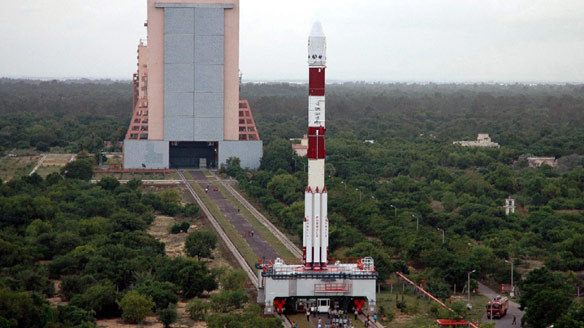
PSLV-C24 rocket successfully launches Indian GPS satellite IRNSS-1B into space
India's Polar Satellite Vehicle (PSLV) has its 25th jubilee flight of the rocket.The satellites will way-point all Indian missiles to their targets with an accuracy of 20 meters.
IRNSS-1B satellite is the second of seven which will make up the Indian Regional Navigation Satellite System (IRNSS). The constellation will consist of four satellites in geosynchronous orbits inclined at 29 degrees, with three more in geostationary orbit. IRNSS-1B is one of the geosynchronous satellites, and is expected to be positioned at a longitude of 55 degrees east.
The earlier IRNSS-1A satellite was launched on July 1st 2013.The PSLV will launch two more such satellites before the end of 2014.
The geostationary satellites will operate at 34, 83 and 132 degrees east. The IRNSS system is expected to provide navigation signals to India with an accuracy of up to 20 meters.The IRNSS-1B will be useful in terrestrial, aerial and sea navigation. It will beam back accurate information on the position of trucks, cars, battle tanks, aircraft, missiles, ships and submarines with precise timing reference. Truck and car drivers, pilots of civilian or combat aircraft and ship captains can properly plan their route using the IRNSS satellites which will guide them towards their destination with the help of a receiver. The satellites will way-point the missiles to their targets.
The IRNSS-1B satellite is based on the I-1K satellite bus and has a fuelled mass of 1,425 kilograms (3,141 lb), or a dry mass of 614 kg (1,354 lb).It is powered by two solar arrays, which generate up to 1,660 watts of power. The spacecraft is expected to operate for ten years.
April 3, 2014
India and Space Defense
Concerned about global trends, India is making progress in building its space defense capabilities.
Fortunately, the final frontier has yet to become a battlefield. On present trends, however, the next two decades will witness a global arms race in space, culminating in a sophisticated weapons system being placed in orbit. The United States and Russia (formerly the Soviet Union) have been active in this sphere since the early 1960s, when the Soviets first tested the “hunter killer” low orbit satellite system. The U.S. responded with a series of advanced strategic missile projects and some more promising ground launched initiatives. Since then, however, both the U.S. and Russia have constrained their space military programs, seeking to discourage weaponization. Still, both countries have made it clear they will start again, should a line be crossed.
In 2007, China sparked global concern when it successfully tested its first ASAT (anti-satellite) missile, destroying one of its obsolete weather satellites at an altitude of 865 km. In 2006, the U.S. government released a report claiming that China had tagged some U.S. observation satellites with a high-power laser system. Although no major damage was done to the satellites, it later emerged that the laser was not directed at the optical lenses, which could have rendered the satellites useless. In 2008, when the Shenzhou-07 was in orbit, the taikonauts on the mission released a BX-1 micro satellite. The BX-1 flew within the 1000-mile secure radius of the International Space Station (the ISS is programmed to change trajectory and orbit should this happen). Although no harm was done, this demonstrated China’s ability to deploy micro satellites with ASAT capabilities.
http://thediplomat.com/2014/03/india-and-space-defense/
Fortunately, the final frontier has yet to become a battlefield. On present trends, however, the next two decades will witness a global arms race in space, culminating in a sophisticated weapons system being placed in orbit. The United States and Russia (formerly the Soviet Union) have been active in this sphere since the early 1960s, when the Soviets first tested the “hunter killer” low orbit satellite system. The U.S. responded with a series of advanced strategic missile projects and some more promising ground launched initiatives. Since then, however, both the U.S. and Russia have constrained their space military programs, seeking to discourage weaponization. Still, both countries have made it clear they will start again, should a line be crossed.
In 2007, China sparked global concern when it successfully tested its first ASAT (anti-satellite) missile, destroying one of its obsolete weather satellites at an altitude of 865 km. In 2006, the U.S. government released a report claiming that China had tagged some U.S. observation satellites with a high-power laser system. Although no major damage was done to the satellites, it later emerged that the laser was not directed at the optical lenses, which could have rendered the satellites useless. In 2008, when the Shenzhou-07 was in orbit, the taikonauts on the mission released a BX-1 micro satellite. The BX-1 flew within the 1000-mile secure radius of the International Space Station (the ISS is programmed to change trajectory and orbit should this happen). Although no harm was done, this demonstrated China’s ability to deploy micro satellites with ASAT capabilities.
http://thediplomat.com/2014/03/india-and-space-defense/
June 4, 2012
First satellite for Indian Navy to be launched in a month
India venturing on a path of weaponize space and also working on Anti-Satellite weapons
NEW DELHI: The Indian Navy is finally set to get their first-ever dedicated military satellite, a naval surveillance and communications one, as part of their long-standing quest to effectively harness the final frontier of space. The geo-stationary naval satellite has "already been shipped out'' for its launch that will take place "within a month or so", government sources said.
A not-too-subtle indicator of the space event in the offing was also the creation of a new post of assistant chief of naval staff (communications, space and network-centric operations) at the Navy head-quarters over the weekend.Though tight-lipped about the "over-the-sea" satellite's launch, the Navy said a communications and electronic warfare specialist, had taken over as the new ACNS (CSNCO) in keeping with its endeavour to transform from a "platform-centric Navy'' to a "network-enabled Navy''.
The satellite, with an over 1,000 nautical mile footprint over the Indian Ocean Region (IOR) stretching from Africa's east coast right till Malacca Strait, will enable the Navy to network all its warships, submarines and aircraft with operational centres ashore through high-speed data-links.
There is an urgent need to keep real-time tabs over the rapidly-militarizing IOR, where China is increasingly expanding its strategic footprint, as well as on troop movements, missile silos, military installations and airbases across land borders.
The long-delayed naval satellite is to be followed by ones for the Army and IAF for "over-the-land use''. In absence of dedicated satellites, the armed forces have so far depended on "dual-use'' Indian satellites as well as lease of transponders on foreign ones for their navigation, communication, surveillance and reconnaissance purposes.
NEW DELHI: The Indian Navy is finally set to get their first-ever dedicated military satellite, a naval surveillance and communications one, as part of their long-standing quest to effectively harness the final frontier of space. The geo-stationary naval satellite has "already been shipped out'' for its launch that will take place "within a month or so", government sources said.
A not-too-subtle indicator of the space event in the offing was also the creation of a new post of assistant chief of naval staff (communications, space and network-centric operations) at the Navy head-quarters over the weekend.Though tight-lipped about the "over-the-sea" satellite's launch, the Navy said a communications and electronic warfare specialist, had taken over as the new ACNS (CSNCO) in keeping with its endeavour to transform from a "platform-centric Navy'' to a "network-enabled Navy''.
The satellite, with an over 1,000 nautical mile footprint over the Indian Ocean Region (IOR) stretching from Africa's east coast right till Malacca Strait, will enable the Navy to network all its warships, submarines and aircraft with operational centres ashore through high-speed data-links.
There is an urgent need to keep real-time tabs over the rapidly-militarizing IOR, where China is increasingly expanding its strategic footprint, as well as on troop movements, missile silos, military installations and airbases across land borders.
The long-delayed naval satellite is to be followed by ones for the Army and IAF for "over-the-land use''. In absence of dedicated satellites, the armed forces have so far depended on "dual-use'' Indian satellites as well as lease of transponders on foreign ones for their navigation, communication, surveillance and reconnaissance purposes.
Subscribe to:
Posts (Atom)