Showing posts with label UAV. Show all posts
Showing posts with label UAV. Show all posts
October 22, 2015

January 1, 2015

October 16, 2014
General Atomics announces historic milestone for its Predator/Gray Eagle UAV
Photo - wikipedia
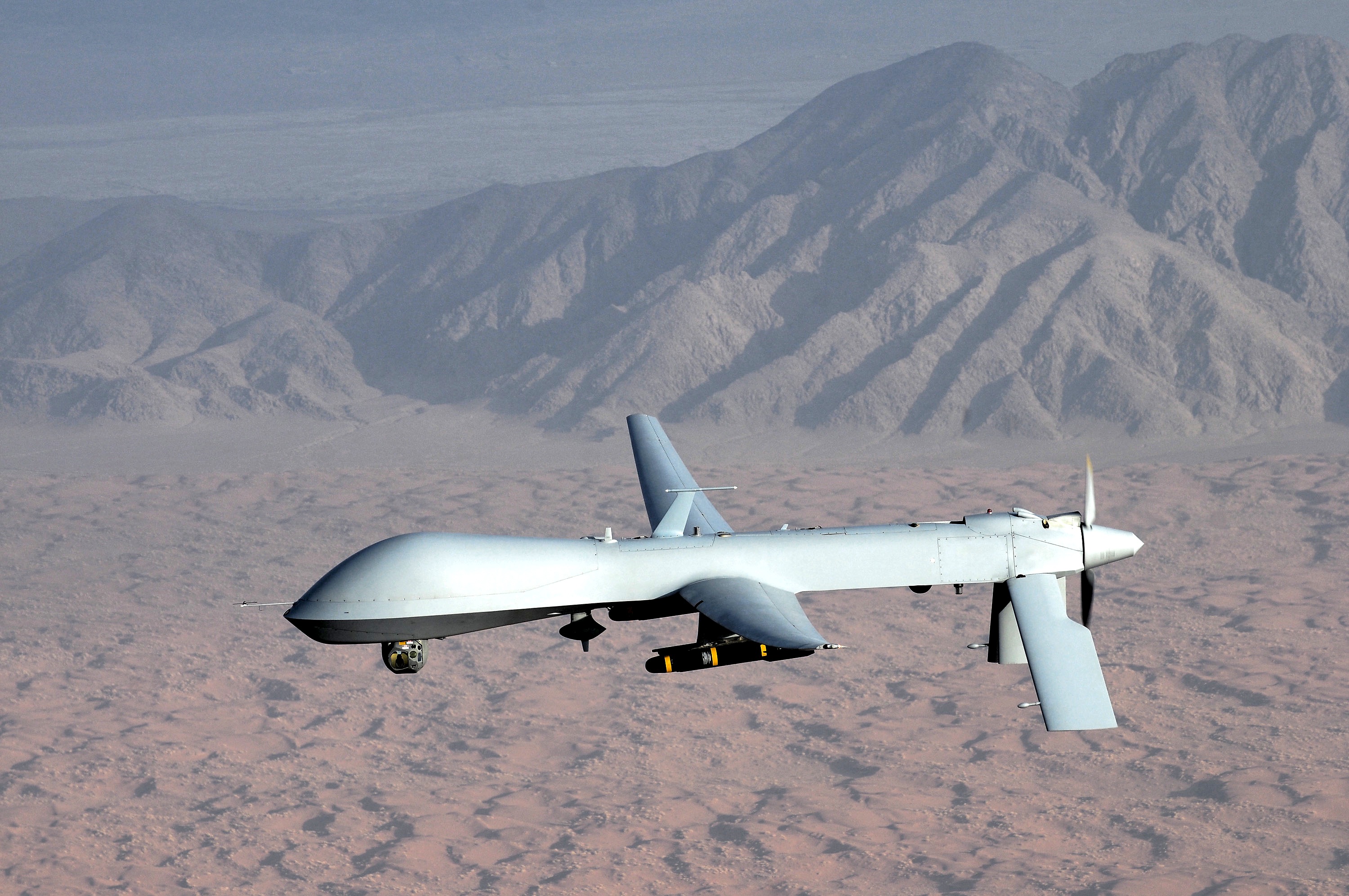
General Atomics Aeronautical Systems, a leading manufacturer of Remotely Piloted Aircraft (RPA) systems, radars, and electro-optic and related mission systems solutions, today announced that its Predator/Gray Eagle-series aircraft family has achieved a historic company and industry milestone: three million flight hours which is the equivalent of flying over 340 years, around-the-clock, every day. The milestone occurred on October 2, with nearly 222,000 total missions completed and almost 90-percent of all missions flown in combat.
September 1, 2014
Tianjin 2014 international UAV and model Exhibition
Photos - Sina

Look at the a/c in the background :) - Same to same


Look at the a/c in the background :) - Same to same
August 27, 2014
August 19, 2014
Aurora SKATE SUAS UAV
Skate's unique capability to autonomously manoeuvre and navigate in urban or crowded environments enables this lightweight air vehicle to deliver long endurance on quiet electric power, and provide autonomous operation. By using tilt-motors Skate merges the simplicity and endurance of a fixed wing platform with the manoeuvrability and mission flexibility of a vertical take off and landing (VTOL) asset. Independently articulating motor pods allow the Skate UAS to rapidly transition between vertical and horizontal flight. Transferring from hovering to wingborne flight increases the endurance and range of the system to levels characteristic of a fixed wing platform and far beyond those of a traditional VTOL asset. The thrust vectoring provided by the motor pods also enables extreme manoeuvrability and rapid navigation of congested environments such as city streets and urban canyons
Are US Air Forces and Chinese PLAAF UAVs the same with minor differences?
US Air Forces X-47B and China's "sword" UAVs the same with minor differences

USAF MQ-9 Predator and and China's Pterodactyl Wing Loong

Only Triton remains one of a kind(not for long)

May 16, 2014
Lockheed Martin Introduces Latest Addition to Small Unmanned Aircraft System Family

Designed for versatility and affordability, the new Lockheed Martin Vector Hawk addresses a broad set of unique missions and operating needs within a single system. With a gross takeoff weight of only four pounds and a vertical profile of only four inches, Vector Hawk boasts best-in-class payload capacity, speed and endurance.
“We are proud to deliver Vector Hawk, a waterproof system that provides leading edge multi-mission capabilities in all environments,” said Kevin Westfall, director of Unmanned Solutions at Lockheed Martin’s Mission Systems and Training business. “The Vector Hawk can be field reconfigured to multiple missions including fixed-wing, vertical takeoff and landing (VTOL), and tilt-rotor enabling VTOL with transition to fixed wing flight. Our fixed wing variants may be hand or tube launched, and VTOL and tilt-rotor variants may be launched from land or water surfaces.”
Vector Hawk features fully autonomous flight, landing and fail-safes. It is inaudible at operational slant ranges. The data link features a high bandwidth software defined radio, mesh networking (including 3G, 4G, and LTE cellular), over-the-air reconfiguration, and is capable of employing a variety of waveforms. With an open architecture, reconfigurable variants, adaptable data link, and scalable payload, Vector Hawk is engineered for unmatched capability.
http://www.lockheedmartin.com/us/news/press-releases/2014/may/140513-mst-lm-introduces-latest-addition-to-suas-family.html
April 30, 2014
April 15, 2014
Video for South Korean Military and like minded democracies under siege by terrorists
How difficult hitting a remotely piloted aircraft can be - Big Sandy MG Shoot 4/2014
Machine Guns vs DRONES
April 6, 2014
Russian UAV design and manufacture catching up with UAVs of other nations
Russia had revealed Altius UAV recently
http://www.asiandefencenews.com/2014/03/a-new-russian-uav.html
http://charly015.blogspot.in/2014/04/mas-de-160-modelos-de-uavs-rusos-11.html
Russian soldier uses laser to dazzles Ukrainian UAV
April 5, 2014
BAE Taranis UCAV At RAAF’s Woomera Airfield
Seems like it is parked there on purpose to be picked up by satellites. The plane hangar is some distance away to the left.
March 28, 2014


February 20, 2014
British Taranis Stealth UCAV is Expanding Flight Envelope over Australia
 |
| A side view of the Taranis UCAV in flight. Photo: BAE Systems/MOD |
 |
| The serrated contour of the weapon’s bay is clearly seen in this photo, where the stealthy Taranis shows its belly and underwing area on a banking turn. Photo: BAE Systems, UK MOD. |
 |
| Taranis awaiting takeoff at Woomera Test Range, South Australia. Photo: BAE Systems/UK MOD |
 |
| Taranis on the runway. Photo: BAE Systems/UK MOD |
Taranis is designed to demonstrate the UK’s ability to create an unmanned air system which, under the control of a human operator, is capable of undertaking sustained surveillance, marking targets, gathering intelligence, deterring adversaries and carrying out strikes in hostile territory.
Taranis made its maiden flight at the Woomera test range in South Australia on Saturday 10th August 2013, under the command of BAE Systems’ test pilot Bob Fraser. The first flight lasted only 15 minutes, in which the demonstrator aircraft took off, rotation, ‘climb-out’ and returned for landing. In a number of follow-on flights that took place last year, Taranis extended flight duration to one hour, operating at a variety of altitudes and speeds, as part of the envelope testing.
“The findings from the aircraft’s flight prove that the UK has developed a significant lead in understanding unmanned aircraft which could strike with precision over a long range whilst remaining undetected.” BAE Sources said, indicating the technological advances made through Taranis will also help the UK MOD and Royal Air Force make decisions on the future mix of manned and unmanned fast jet aircraft and how they will operate together in a safe and effective manner for the UK’s defences. The MOD is considering a yet undefined ‘Future Combat Air System ‘FCAS’ – possibly a UCAV to replace the Eurofighter Typhoon in RAF service as the Typhoon reaches retirement by 2030. The UK and France announced an agreement to explore collaborate in the development of such platform, at an investment of £120 million. The two countries are expected to sign a formal memorandum of understanding (MOU) to launch the two-year program in July 2014.
February 11, 2014
February 8, 2014
USAF Unmanned QF-4 drone crashed Friday


Officials continue their investigation of a QF-4 drone that crashed five miles west of Holloman off of Runway 22 in the White Sands National Monument Friday morning, a spokeswoman said.Dunes Drive inside the monument will remain closed until further notice.
The unmanned QF-4 drone was assigned to the Detachment 1, 82nd Aerial Targets Squadron and is a tenant unit at Holloman assigned to the 53rd Weapons Evaluation Group.Capt. Stephanie L. Schonberger said U.S. Highway 70 West and WSNM were closed in advance due to the unmanned aircraft's routine training mission.
"We're working closely with the Parks Service because clearly we're on their property," Schonberger said. "It's going to affect their operations and visitors for the weekend. There is no threat to the public at this time. The cause of the crash is unknown at this time. We apologize for any inconvenience this might cause."She said the QF-4 was conducting a test mission.
"There was an unmanned QF-4 drone flying with an piloted F-4 manned chase plane with a pilot actually in the cockpit," Schonberger said. "There's always somebody in the cockpit of the F-4 tailing the unmanned QF-4 and watching what's happening with the drone. Those aircraft always fly over the Monument in their approach to land at Holloman. It's a pretty normal flight pattern in going over the monument. That's when it crashed."The QF-4 is one of HAFB's target drones, she said.
"It's an F-4 Vietnam era fighter that's been converted to a remote controlled airplane used as a target plane for other aircraft to shoot down," Schonberger said. "The plane that crashed did not have a pilot and was being controlled remotely. It didn't damage any buildings or structures. No one was injured in the accident. Based on where it went down, Dunes Drive on the monument is closed because there could be debris on the road. Right now, the area is cordon off for safety."Beginning Saturday, our folks will be in there on the ground and really looking at things closely. They will be figuring out what needs to be moved. Our goals here is the safety of park visitors, our folks and getting the opened again."
She said the U.S. Air Force will convene an Accident Investigation Board and a Safety Investigation Board to look into the aircraft crash that occurred around 9 a.m. Friday.White Sands National Monument spokeswoman Rebecca Wiles said it's common practice to close Dunes Drive as a precautionary measure to ensure public safety during missile tests when flight paths include airspace over the monument.
"The closure of Dunes Drive Friday morning before the missile test ensured no injuries resulted from the accident," Wiles said. "The White Sands visitor center and gift shop will remain open from 9 a.m. until 5 p.m. Dunes Drive will remain closed indefinitely while staff from Holloman and White Sands Missile Range investigate the crash site. There is no visitor access to the sand dunes, picnic areas or hiking trails while Dunes Drive remains closed for the investigation and cleanup."Friday's crash follows a QF-4 crash in July 2011 where a manned version of the aircraft crashed near Hope. The pilot safely ejected and was unharmed in the 2011 crash. The last two unmanned crashes occurred at Holloman in August 2006 and September 2004.
The supersonic QF-4 is a reusable full-scale, remotely piloted aerial target modified from the F-4 Phantom. The QF-4 provides a realistic full-scale target for air-to-air weapons system evaluation, development and testing. Holloman is one of two bases to operate the QF-4, with the other being Tyndall Air Force Base, Fla. The QF-4 is being replaced by the QF-16, a supersonic reusable full-scale aerial target modified from an F-16 Fighting Falcon.
January 13, 2014
How the WZ-2000 became China's first unmanned combat air vehicle?
 |
| Model of WZ-2000 |
A former executive of China National Guizhou Aviation Industry Group has revealed how the WZ-2000 became China's first industrially manufactured multi-purpose attack unmanned combat air vehicle (UCAV) a decade ago.
In an interview with the Chinese-language Guizhou Daily, Yang Shaowen, now a member of China's national unmanned aerial vehicle (UAV) expert team, described how the WZ-2000 was developed virtually from scratch in Guizhou until its maiden test flight on Dec. 26, 2003.Explaining that the development of the WZ-2000 had to be kept under wraps for the last 10 years, Yang said his inspiration for building a domestic UAV came out of the Kosovo War. After the United States and NATO employed UAVs at the outbreak of the war in March 1999, Guizhou Aviation chairman Zhou Wancheng, and Yang, who was the company's aircraft design chief at the time, became convinced that unmanned vehicles are the future of modern warfare.
Several months later, Yang looked into the local UAV market and was told that Guizhou was not equipped to research or develop the technology and in any case did not have the requisite market or customer channels. Yang added that Guizhou Aviation was the ninth company in China to tackle UAVs, with none of those that came before it ever successfully carrying out a test flight.
This did not deter Yang, Guizhou Aviation and its parent company, the Aviation Industry Corporation of China, forming alliances with other organizations spearheading UAV research and development in China, including top universities, aviation companies and military research organizations.
A mock up of the WZ-2000 was publicly displayed at the 2000 Zhuhai Airshow, with a more accurate model on display at the 2002 event.The maiden test flight was scheduled for Mao Zedong's birthday on Dec. 26, in 2003. The planned 27-minute test flight lasted 74 minutes after the vehicle had difficulty reading its actual height from the ground, though by the end the UCAV managed to complete several flight maneuvers before a successful landing.
The flight was witnessed by Zhang Xiang, then-deputy commander of the Second Artillery Corps of the People's Liberation Army, as well as other military personnel. Zhang said although the test flight was imperfect, this was expected of new technology, adding that he was impressed with how the testers remained calm when the flight ran into difficulties.
The test flight instilled a lot of confidence in Guizhou Aviation, which surprised many by being the first in the country to do it. After finally earning military approval, Guizhou Aviation, which by then had a dedicated research team of more than 100 people, received its first UAC order in 2005, helping boost funding from a meager 1 million yuan (US$1.65 million) by an additional 10 million (US$16.5 million).
By 2008, the WZ-2000 officially became China's first UAV in industrial production.The second generation WZ-2000 has reportedly undergone significant improvements. On Nov. 13, 2009 in Lanzhou, the capital of northwest China's Gansu province, the WZ-2000 fired its first ammunition, which was reportedly just 1.2 meters off the target from a distance of several thousand meters."In the UAV sector, the most technologically advanced are the US, the UK and China. As for seeing China's most advanced UAV, you'll have to come to Guizhou," Yang said.
November 29, 2013
Iranian Fotros UAV Missing Two Screws :)
This high tech UAV seems to be missing two screws as shown in the above photos.

April 4, 2013
SHEPHERD-MIL, an UAV which looks like a native bird
- It looks like a native bird, with the same flight
characteristics. Capable of gliding at great height with its engine off,
the device is invisible in sensitive missions.
- Especially useful to scare away gregarious birds in civilian and military airfields, as well as for intelligence, surveillance and reconnaissance operations in critical infrastructures, the fight against terrorism, and drug trafficking in areas of difficult access.


SHEPHERD-MIL, a UAV with different applications for intelligence,
surveillance, target acquisition and reconnaissance missions will be
featured along with other products and systems at the exhibition.
EXPAL will
participate in HOMSEC 2013, displaying some of its most innovative
solutions in the security area. Among other products, SHEPHERD-MIL, an
UAV which looks like a native bird with the same flight performance,
will be featured. This UAV is characterized by the glide-ratio and
noiseless motor that make it invisible, silent and unobtrusive in
sensitive missions. SHEPHERD-MIL was initially developed as a bird
strike avoidance system, and currently is used in situations where the
safety and protection are key.
SHEPHERD-MIL, a UAV with different applications for intelligence,
surveillance, target acquisition and reconnaissance missions will be
featured along with other products and systems at the exhibition.
SHEPHERD-MIL is equipped with cameras and geolocation software. The system is especially suitable for border surveillance missions, firefighting, and anti-drug trafficking operations amongst others. Furthermore, EXPAL has adapted and integrated the SHEPHERD-MIL into its Fire Support System (TECHFIRE), transforming the SHPEHERD-MIL into a specific version, Unmanned Forward Observer (UFO-UAV) that functions as a complement for the forward observer.
Subscribe to:
Posts (Atom)
