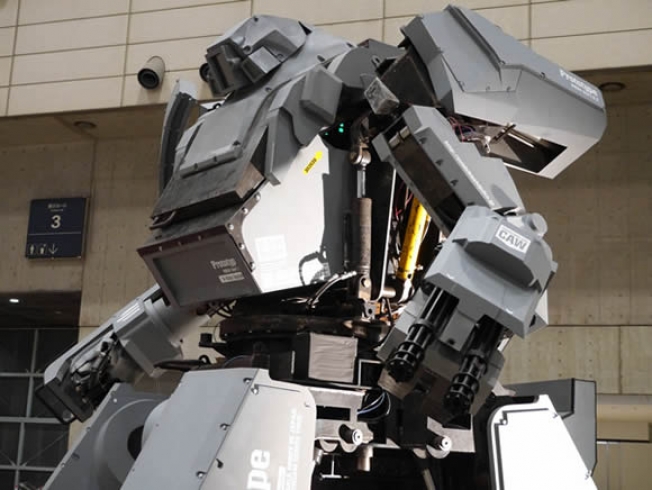
I thought it was unreal when I first saw this...Skynet Terminator is here :O
August 11, 2012
Japanese engineers hasten humanity’s extinction, unveil fully-armed four-ton robot
I thought it was unreal when I first saw this...Skynet Terminator is here :O
PAK-FA Prototype Tests AESA Radar for Russian and Indian Airforce
"Sukhoi" has started testing the fighter T-50 (PAK FA) with a new
on-board radar system with an active phased array, said in a statement
received by the Editor "Lenty.ru." The new radar is installed on the
third prototype of the future fighter T-50-3. In the first ground and
flight tests were checked in the modes of the radar features
"air-to-air" and "air-surface". In parallel testing of optical channels.
Radar PAK FA being developed by the Research Institute of Instrument name Tikhomirov. According to the "Sukhoi", a radar with electronic beam control is made on the basis of the Russian element nanoheterostructures. The system will allow the PAK FA to recognize and classify the group and single target at long range, and at the same time pointing to arms for a few of them. In addition, on-board system will provide communications and electronic countermeasures.
In February 2012 it was reported that the PAK FA prototype made a total of more than 120 flights. The third prototype of the aircraft involved in the flight test program in November 2011. It is expected that during 2012 the program will connect, and the fourth prototype of the T-50-4. The first prototype aircraft flies from January 2010 and the second - in March 2011.
August 9, 2012
India gets hawk eye over Strait of Malacca - INS Baaz
India will on Tuesday formally open a key naval station, aptly named INS Baaz (Hawk), in the southern part of Andaman and Nicobar Islands that will boost its ability to keep an eagle eye on the critical maritime choke-point: the Strait of Malacca.
With navy chief Admiral Nirmal Verma declaring the base open, the nation’s southeastern-most fringe, which is closer to Indonesia than the Indian mainland, India will gain strategic supremacy in the area, an Indian Navy officer said in New Delhi.
The new base, which will also include an upgraded air base, will soon be operating heavier military planes from the Indian Air Force fleet like the just-inducted Hercules C-130J Super Hercules meant for special forces’ operations.
Campbell Bay straddles a strategically key location in the Indian Ocean/Bay of Bengal overlooking the mouth of the Strait of Malacca, from across Aceh in Indonesia. With this, the Indian military will be sitting pretty at a location from where it can kickstart operations if maritime activities in the region are threatened.
Once a piracy-affected region, Indian and Indonesian navies continue to monitor it for criminal activities by jointly patrolling their maritime borders.
India’s move comes even as the US has spelt out its future military strategy to focus on the Asia-Pacific by “re-balancing” its force levels from the Atlantic.
US Defence Secretary Leon Panetta had said at the Shangri La Dialogue in Singapore last month – and in New Delhi earlier – that the US will base at least 60 per cent of its naval assets in the Asia-Pacific region.
The Strait of Malacca acts as a key link between the Indian Ocean and the Pacific Ocean, connecting East Asia, Australia and the US with Asia and Africa.
At least a quarter of the world’s trade – and more importantly, at least 80 per cent of China’s oil requirements – passes through the Strait of Malacca.
India already operates naval bases at Port Blair and Car Nicobar in the Andaman and Nicobar Islands chain.
It also has at least three air strips at Diglipur in the north Andamans, Port Blair and Car Nicobar.
The new base will significantly increase India’s strategic reach in the region, considering that Campbell Bay is about 300 nautical miles south of Car Nicobar, till now the navy’s major forward operating base in the area.
August 7, 2012
India Navy's ‘K-15 Black Project’
India has quietly gate-crashed into an even more exclusive club of nuclear-tipped submarine-launched ballistic missiles (SLBMs). Project found out when top scientist given award
The annual awards function of the Defence Research and Development Organization (DRDO) the other day witnessed Prime Minister Manmohan Singh handing over the “technology leadership award” to a scientist, A K Chakrabarti, of the Hyderabad-based DRDL lab, for the “successful development” of the country’s first SLBM. This capability has been acquired only by four nations, the US, Russia, France and China. Long shrouded in secrecy as a “black project”, unlike the surface-to-surface nuclear missiles like Agni, the SLBM may now finally come out of the closet. Called different names at different developmental phases, which included “Sagarika’’ for an extended period, the SLBM in question is the ‘K-15’ missile with a 750-km strike range. Much like the over 5,000-km Agni-V that will be fully operational by 2015 after four-to-five “repeatable tests”, the K-15 is also still some distance away from being deployed. While the SLBM may be fully-ready and undergoing production now, as DRDO contends after conducting its test several times from submersible pontoons, its carrier INS Arihant will take at least a year before it’s ready for “deterrent patrols”.
India’s first indigenous nuclear-powered submarine, the 6,000-tonne INS Arihant, is still undergoing “harbor-acceptance trials” with all its pipelines being cleared and tested meticulously on shore-based steam before its miniature 83 MW pressurized light-water reactor goes “critical”. The submarine will then undergo extensive “sea-acceptance trials” and test-fire the 10-tonne K-15, which can carry a one-tonne nuclear payload, from the missile silos on its hump.
The sea-based nuclear leg in the shape of SLBMs is much more effective — as also survivable being relatively immune to pre-emptive strikes — than the air or land ones. Nuclear-powered submarines, which are capable of operating silently underwater for months at end, armed with nuclear-tipped missiles are, therefore, considered the most potent and credible leg of the triad. With even the US and Russia ensuring that two-thirds of the strategic warheads they eventually retain under arms reduction agreements will be SLBMs, India with a clear “no-first use” nuclear doctrine needs such survivable second-strike capability to achieve credible strategic deterrence.
August 2, 2012
Subscribe to:
Posts (Atom)