February 23, 2014

Russian Air Force Receives New Stealth Fighter Prototype


A new advanced fighter jet prototype has been delivered to the Russian Air Force for testing, the manufacturer said Friday.The first T-50 “stealth” fighter had been delivered to a military airfield in Russia’s southern Astrakhan region for test flights, the Sukhoi company said in a statement.
The chief air force commander, Lt. Gen. Viktor Bondarev, said in December that combat squadrons could expect deliveries of the production version, known by its Russian acronym PAK-FA for future tactical fighter aircraft, in 2016 at the latest.

The PAK-FA is slated to replace the country’s aging fleet of Soviet-era fighter jets.
The Sukhoi T-50 is a fifth-generation fighter jet and features a stealth profile with internal weapons bays for air and ground-attack weapons, thrust-vectoring engines for high-acceleration turns and an ability known as supercruise to fly supersonic without the use of a fuel-guzzling afterburner.

An export version, called the fifth-generation fighter aircraft (FGFA), is also under development in a joint project with India for that country’s air force.Experts consider the plane comparable to the only fifth-generation fighter currently in operation worldwide, the American F-22 Raptor, which entered service in 2005.The Moscow-based Sukhoi has been conducting its own test flights of several of the aircraft since 2010, including in-flight refueling and high-agility maneuvers. The company said in October that these had produced favorable results.

February 22, 2014

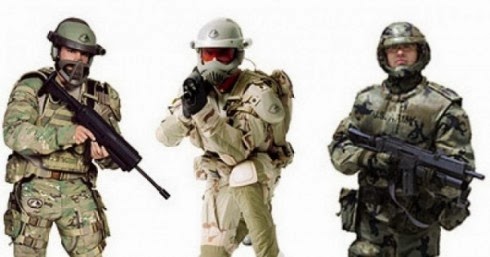
US Admiral : ‘Iron Man’ Prototypes Coming in June


The head of U.S. Special Operations Command said the first prototypes of a new, Iron Man-like protective suit could be ready for testing this summer.Navy Adm. William McRaven said three unpowered prototypes of the so-called Tactical Assault Light Operator Suit — known in military parlance as TALOS and dubbed the Iron Man suit after the one worn by the Marvel Comics superhero — are being assembled and expected to be delivered in June. The plan is to evaluate the technology with the goal of fielding a system by August 2018, he said.

“That suit, if done correctly, will yield a revolutionary improvement in survivability and capability for special operators,” McRaven said during the 25th annual Special Operations and Low-Intensity Conflict conference on Tuesday in Washington, D.C. The three-day event continues Wednesday and was organized by the National Defense Industrial Association, an Arlington, Va.-based trade group.The technology may eventually include a powered exoskeleton, advanced full-body armor and situational-awareness displays, according to the command’s official request for information.
The idea for the project came about several years ago after a member of special operations forces was shot and killed while entering the door of a suspected insurgent, McRaven said. A young officer asked him a question he couldn’t answer: After all these years in combat, why isn’t there a way to better protect operators going through the door?

“With all the advance in modern technology, I know we can do better,” McRaven said.
Some 56 corporations, 16 government agencies, 13 universities and 10 national laboratories are working on the program, McRaven said. “We are already seeing astounding results of this collaboration,” he said.The command also plans to hold a “Monster Garage” event to encourage mechanics and master craftsmen alike to develop components for the suit, McRaven said. It may also seek authority from the Pentagon to distribute prize money to generate even more interest in the effort, he said.

The applied technology project has the potential to provide the U.S. with a “huge comparative advantage over our enemies and give our warriors the protection they need,” McRaven said.


World War II:Strange Allied Weapons


February 21, 2014

BAE Systems Q-Warrior revolutionary helmet mounted display system for Special Forces personnel


The Q-Warrior™- the latest iteration of BAE Systems helmet-mounted display technology, looks like a pilot's head-up display but has been specially designed for the soldier who needs unique capabilities, such as identifying hostile and non-hostile forces, as well as co-ordinating small unit actions. A revolutionary helmet mounted display system designed to provide soldiers and Special Forces personnel with more real-time visual data than ever before is exceeding expectations in field testing with US military researchers.

Designed and built by engineers at our Electronic Systems business in Rochester, Kent, the system significantly increases situational awareness capabilities for the 'dismounted soldier' - in other words military personnel operating out of their vehicles. Q-Warrior™ introduces a high transmission and high luminance see-through display which incorporates a high-resolution colour, collimated display to allow the use of symbols and video to blend intuitively with the user's view of the world. Waypoints, other points of interest and targets can all be displayed overlaid on the real view of what's actually out there.

Paul Wright, Soldier Systems' Business Development Lead at BAE Systems' Electronic Systems in Rochester, Kent, said these are only some of the innovations which have been incorporated into the new display. “Q-Warrior™ increases the user's situational awareness by providing the potential to display “eyes-out” information to the user, including textual information, warnings and threats,” he said. “Other key features include enhanced night vision, waypoints and routing information, and the ability to track both personnel and assets.“The biggest demand, in the short term at least, will be in roles where the early adoption of situational awareness technology offers a defined advantage,” added Mr Wright. “This is likely to be within non-traditional military units with reconnaissance roles, such as Forward Air Controllers/Joint Tactical Aircraft Controllers (JTACS) or with Special Forces during counter terrorist tasks. The next level of adoption could be light role troops such as airborne forces or marines, where technical systems and aggression help to overcome their lighter equipment.”

Q-Warrior™ also features a large eye-motion box to allow the soldier to make relatively large movements of his or her helmet while continuing to maintain his view of the display.Although it is expected that Q-Warrior™ will initially be employed at the section commander level, the technology could become an essential but standard issue piece of kit for every soldier.The Q-Warrior™ builds upon technologies developed for our Q-Sight® range of display systems.

February 20, 2014

British Taranis Stealth UCAV is Expanding Flight Envelope over Australia


A side view of the Taranis UCAV in flight. Photo: BAE Systems/MOD
The serrated contour of the weapon’s bay is clearly seen in this photo, where the stealthy Taranis shows its belly and underwing area on a banking turn. Photo: BAE Systems, UK MOD.


Taranis awaiting takeoff at Woomera Test Range, South Australia. Photo: BAE Systems/UK MOD

Taranis on the runway. Photo: BAE Systems/UK MOD
Last week the UK Ministry of Defence (MOD) and BAE Systems confirmed that the Taranis stealthy Unmanned Combat Air Vehicle (UCAV) demonstrator surpassed all expectations during its first flight trials last year. Since the first flight, conducted August 10th, 2013 the UCAV has been expanding the flight envelope in preparation for the follow-on operational demonstration phase.

Taranis is designed to demonstrate the UK’s ability to create an unmanned air system which, under the control of a human operator, is capable of undertaking sustained surveillance, marking targets, gathering intelligence, deterring adversaries and carrying out strikes in hostile territory.

Taranis made its maiden flight at the Woomera test range in South Australia on Saturday 10th August 2013, under the command of BAE Systems’ test pilot Bob Fraser. The first flight lasted only 15 minutes, in which the demonstrator aircraft took off, rotation, ‘climb-out’ and returned for landing. In a number of follow-on flights that took place last year, Taranis extended flight duration to one hour, operating at a variety of altitudes and speeds, as part of the envelope testing.

“The findings from the aircraft’s flight prove that the UK has developed a significant lead in understanding unmanned aircraft which could strike with precision over a long range whilst remaining undetected.” BAE Sources said, indicating the technological advances made through Taranis will also help the UK MOD and Royal Air Force make decisions on the future mix of manned and unmanned fast jet aircraft and how they will operate together in a safe and effective manner for the UK’s defences. The MOD is considering a yet undefined ‘Future Combat Air System ‘FCAS’ – possibly a UCAV to replace the Eurofighter Typhoon in RAF service as the Typhoon reaches retirement by 2030. The UK and France announced an agreement to explore collaborate in the development of such platform, at an investment of £120 million. The two countries are expected to sign a formal memorandum of understanding (MOU) to launch the two-year program in July 2014.

Indonesia has ordered Rheinmetall-made Oerlikon Skyshield air defence system


In recent weeks Rheinmetall has won major orders in the field of military air defence. Indonesia and a European nation have ordered air defence products for air force and naval applications which, together with accompanying services, are worth a total of about €50 million.

Indonesia has opted to expand its existing Rheinmetall-made Oerlikon Skyshield air defence systems with a follow-on order for Skyshield fire units. Worth over €38 million, the contract includes training and logistical services for the Indonesian armed forces. The delivery period extends through to the end of 2015.

Rheinmetall is one of the world’s leading makers of sophisticated short-range air defence systems. It is the market leader in cannon-based air defence, and the only single-source system supplier of fire control technology, automatic cannon, integrated guided missile launchers and the Group’s proprietary Ahead ammunition.

With its tried-and-tested 35mm Skyshield technology, Rheinmetall has set an internationally unsurpassed standard for excellence, especially when it comes to protecting public venues and critical civilian infrastructure from terrorist threats.Skyshield air defence system is a modular, light weight, Short Range Air Defense (SHORAD) system developed by the Swiss corporation Oerlikon Contraves (now a subsidiary of Rheinmetall of Germany).

The weapons system itself consists of two 35 mm (1.38 inch) Revolver Cannons with a rate of fire of 1,000 rounds per minute, a Fire Control System made up of a sensor unit and a detached command post. The Skyshield can also use up to two surface-to-air missile 8-cell modules for an expanded air defense capability. The Skyshield is designed for traditional anti-aircraft roles in addition to defense against missiles.

February 19, 2014

Ordnance Factory Board of India to showcase prototype 6 of Dhanush 155mm 45 calibre howitzer


Ordnance Factories Board (OFB) of India presents the latest prototype of its 155mm 45 calibre Dhanush towed howitzer at Defexpo 2014, the International Defense Exhibition of New Delhi, India. OFP is an industrial setup functioning under the Department of Defence Production of Ministry of Defence, Government of India.

Manufactured by the Ordnance Factory Board, based on technology supplied by Bofors, Dhanush howitzers (155 mm/45 calibre) has a maximum range of 38 km.

Later this month, the Indian-made towed howitzer would be send to Sikkim firing range for another round of trial tests to check its accuracy and range. “We already have a written request from the Army to make 128 of these guns for which we began procuring the material,” an OFB official told Deccan Herald at Defexpo 2014.

The Indian Army has not purchased any artillery gun since the Bofors came in the 1980s. The Swedish howitzers proved its mettle during the Kargil war, but, since then a large of number of artillery guns had to be cannibalized to keep the remaining functional. As repeated efforts to buy new heavy artillery failed in the last decade, the Defence Ministry finally dusted out the old licensing agreement and asked the OFB to manufacture these guns. The Gun Carriage Factory (GCF) in Jabalpur is the integrator, though other units made crucial parts.

Today, six prototypes of the Dhanush howitzer were manufactured. The one displayed at DefExpo is the sixth one, which the OFB claimed to have modified.

The Dhanush is a 155 mm/45 calibre, the use of a longer barrel increases the maximum firing range. Currently, the Indian army standard towed howitzer is the Bofors 155mm 39 calibre which has a maximum effective range of 27 km, while the Dhanush can fire up to 38 km.

The Dhanush is also equipped with a crane and an auto-loading system mounted to the rear and right side of the main gun.

According to Indian Army officials, The Dhanush could fire eight rounds per minute, while the Bofors has a rate of fire of three rounds per 14 seconds. Its also equipped with computerized fire control.

Malaysia selects Thales SMART-S Mk2 radar and CAPTAS- 2 towed sonar confirmed for LCS program


CAPTAS- 2 towed sonar 
Thales SMART-S Mk2 radar

Thales announces that it has signed a Letter of Award with Contraves Advanced Devices Sdn. Bhd. to supply six SMART-S Mk2 naval surveillance radar systems, as well as six CAPTAS-2 towed sonar systems for the Royal Malaysian Navy’s Second Generation Patrol Vessel (SGPV) Littoral Combat Ships (LCS).

The six SMART-S Mk2 radars will be installed on the Malaysian Littoral Combat Ships that are currently being built by Boustead Naval Shipyard Sdn Bhd in Malaysia. The first SMART-S Mk2 is expected to be delivered within the next few years. Thales in Hengelo (The Netherlands) will build and test the first two radars; the other four systems will be assembled and tested by Contraves in Malaysia, using Thales components and know-how.

The Royal Malaysian Navy has also selected the CAPTAS-2 which is part of the CAPTAS1 family of Active Variable Depth Sonar (VDS). CAPTAS-2 is designed to perform against quiet submarines, enabling surface platforms to carry out all Anti-Submarine Warfare missions such as escort, prosecution, area sanitisation and own force protection.

The CAPTAS-2 Variable Depth Sonar comprises state-of-the-art innovative technologies that provides a high source level in a compact array. Furthermore, Thales’s unique towed triplet receive array provides instant left/right ambiguity resolution, and is ideally suited for torpedo defence.Thales is the European leader in naval radars and number one internationally for sonars and underwater systems. This new success confirms the position of the Group as a trusted partner to Navies worldwide.

Future Royal Malaysian Navy Littoral Combat Ships, based on French Shipyard DCNS' Gowind combat design, will be fitted with the following systems:
- BAE Systems Bofors 57mm stealth main gun
- SETIS combat management system
- Rheinmetall Fire Control Systems (TMX/EO Mk2 and TMEO Mk2) 
- MTU engines. 

The length of the LCS will be 111 meters with a displacement of about 3,000 tons. According to the general consens and rumors in the industry, the Malaysian "second-generation patrol vessels" will also come with:
- Thales Smart-S Mk2 radar
- Thales Captas 2 towed array sonar
- MSI-Defence 30mm guns
- MBDA Mica VL for air defense in VLS cells
- MBDA MM40 Exocet BlkIII anti-ship missiles


About SMART-S Mk2 

This contract raises the number of SMART-S Mk2 radar systems sold to well over 50. With the first system under contract in 2003 and operational in 2006, this radar is the world’s market leader in naval medium to long range 3D surveillance radar

About CAPTAS-2

Thanks to substantial investments into the development of the CAPTAS family, CAPTAS-2 has benefitted from the on-going evolution of Thales’s sea proven technologies, ranging from acoustic components to the most state-of-the-art software processing.

Within the last 20 years, more than €250M of Research & Development investment has allowed Thales to build an unprecedented expertise in very low frequency active towed sonars. Thales’s leading position in many fields such as wideband free-flooded ring transducers and triplet receive arrays, has enabled the company to develop the best Anti-Submarine Warfare tactical assets with the CAPTAS sonars. 

Operational at sea in major navies, the CAPTAS family is de-facto the world’s lowest frequency VDS standard with the largest installed base. It is also the only low frequency VDS servicing NATO countries and in service with multiple navies including the Norwegian Navy, the Royal Saudi Navy, the UK Royal Navy, the French Navy, the Italian Navy, the Royal Moroccan Navy and the UAE Navy. Furthermore, CAPTAS has been selected by the US Navy for an Advanced Demonstration Model (ADM).
Related Posts Plugin for WordPress, Blogger...